Overview:
Research is currently ongoing as part of An Taisce’s Legacy4Life project to deliver a low carbon town plan, created with input from stakeholders living, working, and doing business within the community of Maynooth, County Kildare. The plan seeks to identify improvement opportunities that could be available, and to outline the steps to implementing such improvements. To assist reducing Green House Gas emissions at local community level, choices shall be informed by calculation of baseline Green House Gas emissions across multiple emission sectors.
Working with stakeholders in County Kildare, the first phase of this ambitious plan is to identify the live data sets that will feed into Maynooth’s low carbon plan. This data can then be updated annually, so that the town’s electoral division of 15,000 people will have near real time visibility on progress, or blocks to progress in emission reductions. Baseline emissions data shall where possible be extracted from 2022 data in line with the latest census.
The completed Low Carbon Town Plan will deliver a step-by-step process to guide other communities beyond Maynooth in planning their own pathways to low carbon improvements. As such the plan will need to provide an accurate representation of the true sectoral emissions at the local level. The low carbon plan being trialled for Maynooth needs to be easily replicable for both future iterations, in order to keep the plan live, and to also
allow the plan to be replicated elsewhere. Using Maynooth’s low carbon town plan as a framework it is also intended to assess its transferability to rural locations. In terms of the input from community stakeholders this is likely to focus on the following areas:
(A) Social perspectives of community stakeholders
(B) Prioritise low carbon target areas of greatest concern to community stakeholders using a Scenario Planning Exercise.
There may also be opportunities to work with local stakeholders in identifying additional emissions data that are available at the local level, and to assist with citizen science mapping and surveys.
It is hoped that the derived low carbon plan will remain as a live document for annual improvement and assessment, and that it will be replicated by other rural and urban communities across Ireland.
Institutional and Other Barriers:
The barriers to creating and implementing such a low carbon plan will also be identified as part of this project. These may be institutional, financial, data, or awareness related barriers. Some issues have already been identified, and potentially the most challenging is the fact that much data related to different sectoral emissions is held by different institutions, and that it tends to be aggregated at the national level making collecting baseline emissions for local communities a challenge.
Another area of important consideration is defining a suitable set of sectoral themes for emissions and their subsequent improvement. Because national and local authority climate action plans, adaptation strategies, and other associated plans use different but related nomenclature for defining emission sectors, and related actions, there is likely to be confusion at the local level as to which emission sources belong to which emission sectors. This could lead to overlap between one emission sector and another, and potentially the double counting of emissions or sequestration of carbon and greenhouse gases. A good example here is the acquisition of emission data for the Agricultural sector, and for the Land Use & Land Use Change & Forestry sector. The latter can serve to encompass the emissions or sequestration provided by the Natural Capital or Green Infrastructure of a low carbon plan’s catchment area. It will require care not to include agricultural land within the Land Use & Land Use Change & Forestry sector, and vice versa.
An additional complication here has been the difficulty in accessing data for non-agricultural land use cover. A well established data source for land use is the CORINE Land Cover (CLC) inventory, which is a Pan-European land use and land cover mapping programme. It supplies spatial data on the state of the European environmental landscape and how it is changing
over time. However, CORINE only provides a resolution of 25 hectares which is not enough to identify most parks, gardens, ponds, etc. Furthermore, the land use types indicated by CORINE for the Maynooth electoral division are too restrictive, displaying only Continuous Urban Fabric, or Pastures. Further investigation of alternative land use data sources is ongoing with enquiries being made to the EPA, NUI Maynooth, and Kildare County Council. It may prove to be the case that land use data is not yet available or extensive enough at the local level in Ireland to facilitate the capture of such emissions. An alternative option could involve the citizen science mapping of local land use features coupled with the EPA emissions factors for land use to deliver local level land use emissions and/or sequestration of carbon.
Community Low Carbon Planning:
Community participation with data acquisition will be a vital part of the process for developing a usable low carbon plan. This is required to deliver intelligence on the opinions, preferred low carbon scenarios, and the improvement projects that are likely to receive the required level of support in order to succeed. It is also the case that greater community engagement with a low carbon community plan can be anticipated where the community has had a role in defining its preferred direction of travel.
Community participation, or citizen engagement as it is referred to within climate action plans, is recognised as being vital for reaching Ireland’s 2030 and 2050 emission targets. This is because it will require a strong effort at community engagement to carry the message of energy and climate awareness into people’s lives and to affect our collective behaviour. To carry the public along the journey toward 2050 carbon neutrality we will need to include
stakeholders in the planning of our low carbon towns and communities, and to adjust on societies terms when necessary.
The importance of community participation is addressed within national policy and legislation pertinent to climate action and a future low carbon economy. Within the “Public Involvement” section of the “Pre-Legislative Scrutiny on the draft of the 2021 Climate Action Bill” by the Joint Committee on Climate Action, it was recommended that the new bill should:
“implement a permanent, large scale public involvement strategy to include:
- informing members of the public, including vulnerable and impacted
communities, about the targets specified by virtue of the Act;
- encouraging and supporting them to contribute to the achievement of
those targets;
- affording them opportunity to inform carbon budget preparation and
climate policy more generally.
The public involvement strategy must, in particular, identify actions which persons in Ireland may take to contribute to the achievement of climate neutrality.”
(Joint Committee on Climate Action, 2020, p.34).
The resulting Climate Action and Low Carbon Development (Amendment) Bill 2021 instead delegate’s public involvement to a local authority consultation as part of their local authority climate action plan:
“In making the local authority climate action plan, a local authority
shall—
(b) consult with the Public Participation Network in the administrative
area of the local authority and such other persons as the local authority considers appropriate,”
(GOVERNMENT OF IRELAND, 2021a, p25)
Regardless, the Climate Action and Low Carbon Development (Amendment) Act 2021, has now made a legal commitment for Ireland to be climate neutral no later than 2050, and to reduce emissions by 51% by 2030. This will need to be delivered by consulting with communities on how they can, and will, be prepared to deliver on these legal commitments. The importance of societal understanding, and support for Ireland’s climate action measures are pointedly made within the 2019 National Climate Action Plan:
“Those societies who delay the transition needed will face higher costs and fewer opportunities. This plan is designed to demonstrate the determination of Government to shape a path to a decarbonised world. However, what is unique about this challenge is that change must happen in every home, in every workplace and in every network which supports our lifestyle. This requires a very high level of engagement, buy-in and motivation.” (GOVERNMENT OF IRELAND, 2019, p135)
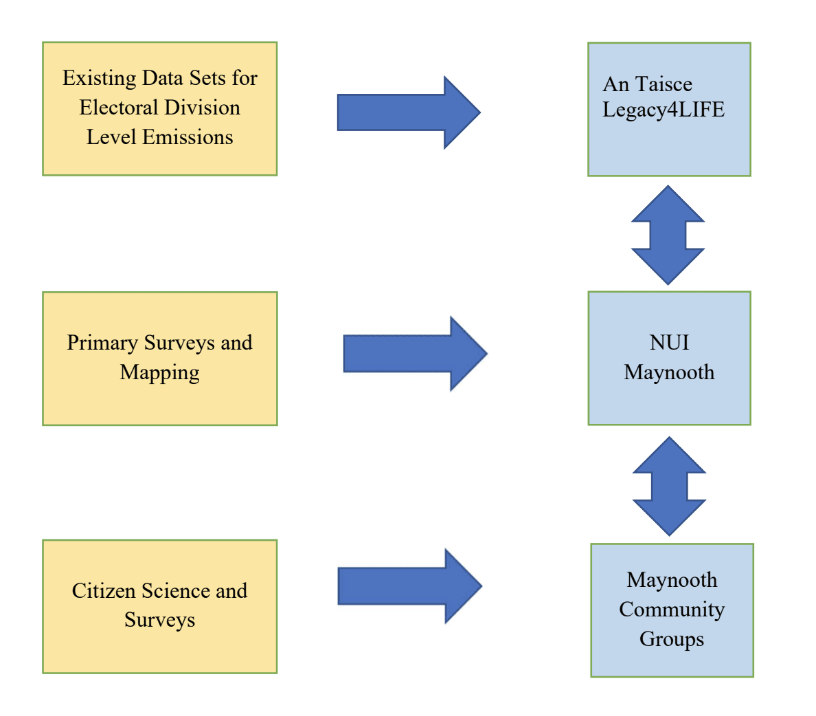
The acquisition of baseline emissions data, and further research into emissions reduction options and preferences, will be addressed in the following manner for Maynooth’s low carbon plan:
Ireland's 2021 Climate Action Plan:
The 2021 Climate Action Plan was published on the 4th of November 2021, by the Department of the Environment, Climate and Communications, on behalf of the Government of Ireland. This latest Climate Action Plan looks in greater detail, than the previous 2019 plan, at the emissions savings to be delivered by the 6 thematic sectors of: Electricity, Transport, Buildings, Industry, Agriculture, and Land Use/Change and Forestry. It also attempts to assign a projected costing of achieving these emissions savings, and to break this down into transferred costs (those that would have been incurred anyway), and incremental costs (new costs to be borne by the economy and society).
Many of the actions and changes to lifestyle identified within both the 2019 and 2021 Climate Action Plan will require upfront costs and some inconvenience to stakeholders and the wider public, although many of these low carbon technologies and actions will ultimately deliver cost savings and opportunities for growth in the longer term. To ensure
the benefits and costs are shared across society the plans contain sections addressing “Just Transition”. Situations where these costs cannot easily be mitigated will also be identified within the Green Communities Low Carbon Plan. One obvious example related to the retrofit of residential dwellings for greater energy efficiency is identified within the 2021 Maynooth Energy Master Plan. This identifies the need for a mechanism to engage with rented properties to facilitate retrofit and engagement with the Renewable Energy Support Scheme:
“Homes rented from private landlords can suffer from a phenomenon called split incentives where landlords do not feel the benefits from improving energy efficiencies as tenants pay electricity and heating bills. A strong strategy of engagement and encouragement will be required for landlords until obligatory measures are put in place around rented accommodation upgrades.”
(ORS, 2021, p21)
The 2021 Climate Action Plan contains an entire section of “Citizen Engagement”, which is indicative of the importance of public engagement in delivering on the aims of the climate action plan itself:
“Our experience to date shows that, as we move forward, we need systematic and active engagement with stakeholders and the public across Ireland at local and national level.”
(GOVERNMENT OF IRELAND, 2021b, p57)
The plan states that the National Dialogue on Climate Change will provide the strategic vehicle for this public engagement and participation in the following key ways:
“1. Improving climate literacy by creating awareness about, and promoting understanding of, climate change.
- Funding, supporting, and enabling active engagement in climate action at a local and national level, conducting public consultations, and promoting self-efficacy by empowering the public to adopt more sustainable behaviours.
- Capturing insights from engagement activities and conducting social and behavioural research to measure behavioural change and provide an evidence base to inform the Climate Action Plan and sectoral climate policies.”
(GOVERNMENT OF IRELAND, 2021b, p58)
It is the opinion of An Taisce Legacy4LIFE that the creation of a Green Communities Low Carbon Town Plan template and methodology, based on the research being conducted with stakeholders in Maynooth, will deliver significant progress across all three of these National Dialogue on Climate Change objectives. If the derived low carbon plan proves to be implementable, and replicable, then there is the opportunity to partner with the National Dialogue on Climate Change to implement an accredited Green Communities Low Carbon Plan programme nationally:
“The majority of the NDCA work programme will involve the design and delivery of activities to help people and stakeholders take an active role in delivering on climate action. This includes providing funding for innovative projects and ideas, …”
(GOVERNMENT OF IRELAND, 2021b, p60)
Inevitably the 2021 Climate Action Plan has a strong economic focus, and much of the plan puts forward the need and benefit to businesses in engaging with both the plan and the Green Recovery. The rational for this is succinctly summarised thus:
“Delivery of CAP21 could benefit Irish businesses in various ways. For Irish business, the stakes are high. The strong global commitment to net-zero and the 'race to the top’ that is underway means that not acting carries a real risk of being left behind – producing outdated products for changing markets and consumer demands.”
(GOVERNMENT OF IRELAND, 2021b, p31)
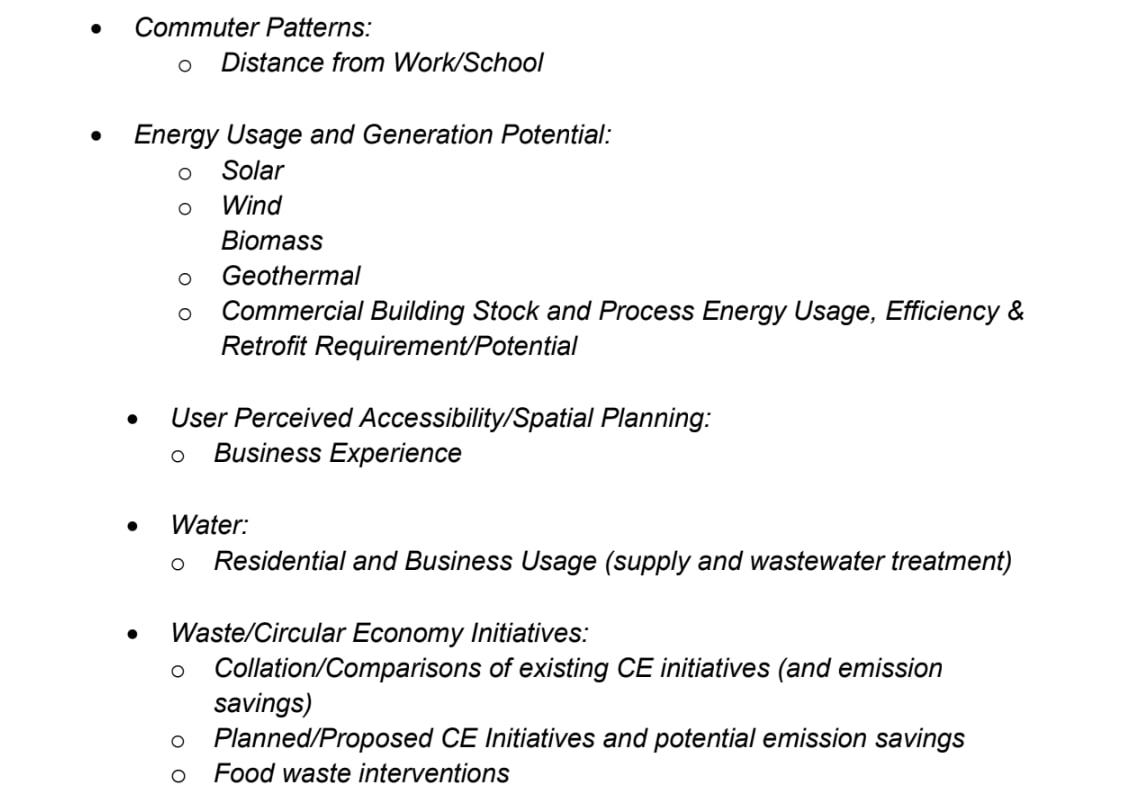
As would be expected, many of the draft sectoral themes dealing with emissions for Maynooth’s Low Carbon Plan are pertinent to business and commercial activity. Among them the following will be prominent:
Ireland’s National Inventory Report on Green House Gas Emissions:
The high level of community engagement that will be engendered by a low carbon plan of this nature is clearly required, as is indicated by the Environmental Protection Agency’s provisional National Inventory Report for 2021. In Ireland it is the Environmental Protection Agency (EPA) that has overall responsibility for the country’s national greenhouse gas
inventory. For each year a National Inventory Report (NIR) is prepared by the EPA, and then submitted to the EU and the UN. Currently Ireland’s most recently published National Inventory Report for Greenhouse Gas Emissions covers the period from 1990-2020. While the National Inventory report for Ireland’s Greenhouse Gas emissions 1990-2021 will not be due for publication until October 2023, provisional estimates of our greenhouse gas emissions for the time period 1990-2021 have been made available in advance of the final inventory data being submitted to the EU and United Nations in 2023. These provisional results indicate that Ireland’s overall greenhouse gas emissions increased by 4.7 % from 2020 to 2021, and this constitutes an increase of 2.76 Million Tonnes of CO2 equivalent green house gas emissions above our 2020 emissions. When the additional sectoral theme of “Land Use and Land Use Change and Forestry” is included the increase in our emissions inventory is 5.5% at 3.59 Million Tonnes of CO2 equivalent green house gas emissions above our 2020 emissions level.
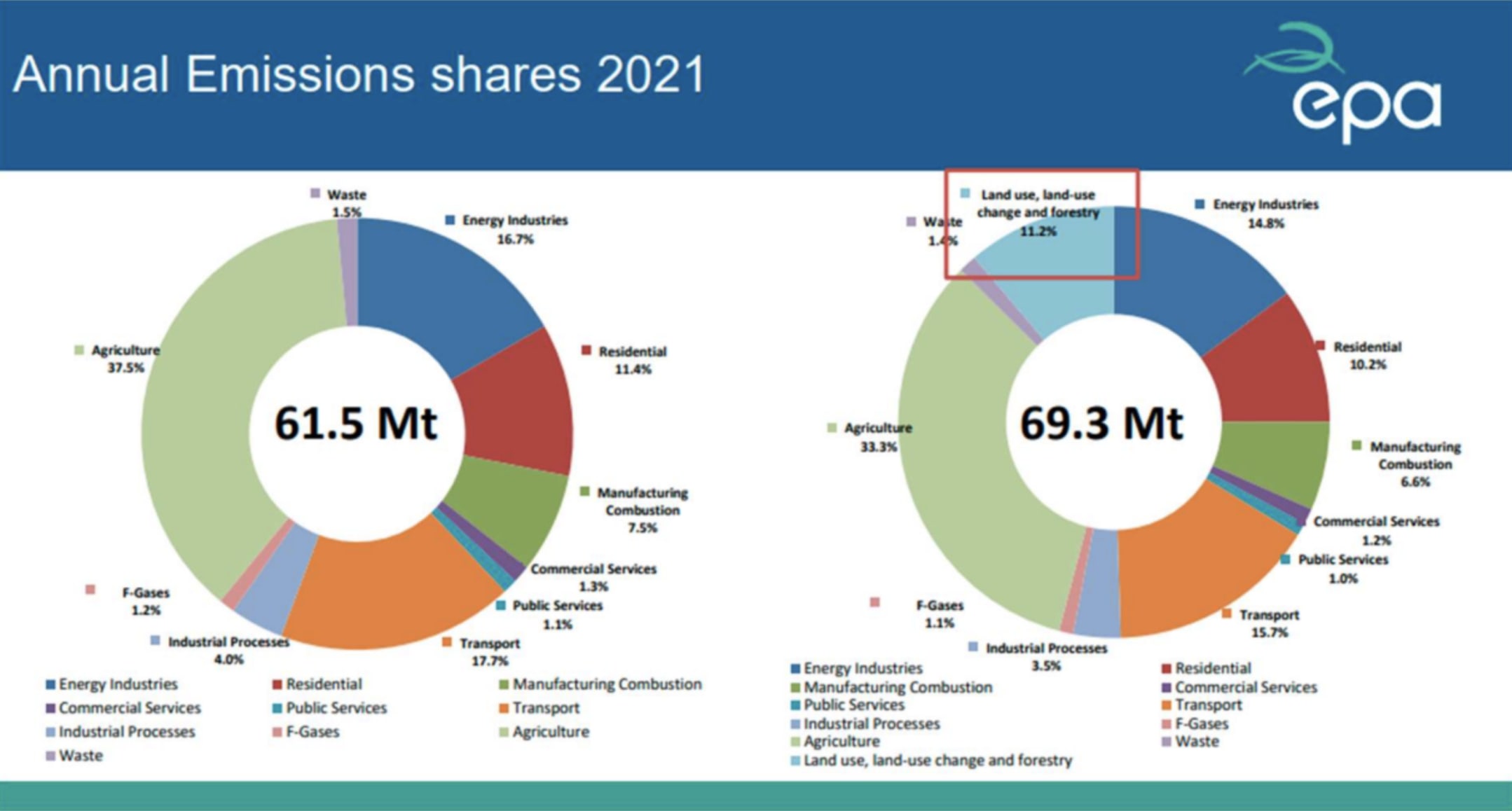
Ireland’s 2021 annual emissions in Mega Tonnes of CO2 equivalent, without (left) and with Land Use and Land Use Change and Forestry (right) emissions. EPA Slide from Ireland’s Provisional Greenhouse Gas emissions 1990-2021 briefing on 21st July 2022.
The main sectoral contributors to the emissions increase were:
? Energy Industry +17.6%
? Transport +6.1%
? Agriculture +3.0%
? Residential -4.9%
The main drivers for this increase in our 2021 inventory were greater coal usage, and less wind generation within the energy sector that meant more emissions from electricity
generation. There was 16% less wind generated electricity, and a 20% decrease in hydro electric generation in 2021 than the previous year, which in turn led to a tripling of coal and oil use in 2021 compared to 2020.
Transport emissions increased largely due to the lifting of COVID restrictions, and a return to commuting to work. These factors did also have the positive benefit of reducing our residential sector greenhouse gas emissions by 4.9% as people returned to work from home after numerous lockdowns.
The continued emission increases from agriculture are driven primarily by enteric fermentation of dairy cattle and other farm animals releasing methane. It is worth noting that a single dairy cow produces the same amount of CO2 equivalent green house gas emissions as a house, at 3.8 tonnes of CO2 equivalent emission per year!
Land Use Carbon Emissions and Removals:
The sectoral theme of “Land Use and Land Use Change and Forestry” is of particular interest to low carbon planning as it is the only sectoral theme that offers us the ability, albeit on a limited scale, to actually remove carbon as opposed to just reducing carbon emissions as is the case with other emission sectors. This is because some forms of land use actually remove carbon dioxide from the atmosphere, and carbon from soil and water, namely; Forestry, Crops, and Harvested Wood Products.
One surprising feature of the EPA’s “Data for Ireland’s Provisional Green House Gas Emissions 1990-2021” is that wetlands have been consistently a source of significant emissions, rather than a sink for carbon sequestration. This data is available for download from the EPA website, and indicates that wetlands were responsible for:
“2.9% [of all National Green House Gas Emissions in 2021, at] 2003.45 Kilotonnes CO2eq [in 2021]”
(EPA, 2022a)
While it is not surprising that wetlands contribute to green house gas emissions, through the anaerobic breakdown or organic material, it would not have been expected that this would contribute toward Ireland’s Green House Gas emissions as:
“Globally, natural wetlands contribute significantly to total GHG emissions to the atmosphere. Natural emissions, however, are not considered under normal UNFCCC reporting procedures.”
(O’Brien P, EPA, 2007, p35)
However, much of Ireland’s wetlands have been drained to provide land for agriculture, forestry and/or peat extraction:
The IPCC Wetlands category has been sub divided into natural unexploited wetlands (unmanaged), and exploited peatlands, the latter being managed wetland areas that are drained for the purpose of commercial and domestic harvesting of peat for combustion (in 1.A.1.a, 1.A.1.c and 1.A.4.b) and/or horticultural use.
(EPA, 2022b, p192)
The degradation of Ireland’s wetlands has resulted in stored organic carbon being exposed to the air and oxidising to create carbon dioxide emissions, as well as increasing the amount of dissolved organic carbon (DOC) that is removed from the former pristine wetland through drainage.
“Ireland’s land use, land use change and forestry sector is currently a carbon source rather than a carbon sink. To reduce emissions and move to being an overall store of carbon, will involve further bog rehabilitation, increased afforestation, improved management of grasslands on mineral soils, increasing the use of cover crops in tillage, and the rewetting of organic soils.”
(GOVERNMENT OF IRELAND, 2021b, p10)
Considering the potential for Ireland’s peat bogs to provide a carbon sink this is disappointing, because:
Intact peatlands are an efficient carbon sink, but damaged peatlands are a major source of greenhouse gas emissions, annually releasing almost 6% of global CO2 emissions. (Tierney N, BBC, 2020)
For reference here are the emission factors for Irish wetlands, as specified by the IPCC Wetland Supplement (CO2 only, CH4 and NOX have additional emissions factors):
Peat Extraction [Peatlands]:
For CO2 emissions, default on-site EF-land 2.8 t C ha-1 and the EF_DOC [Dissolved Organic Carbon through drainage] of 0.31 t C ha-1
Rewetting of Organic Soils [Rehabilitated Peatland/Bogs]:
On-site emissions are estimated based on the area of rewetted soils, the default emission factor EFCO2 of -0.23 (Table 3.1 and Eq 3.4 of the 2013 IPCC Wetland Supplement). Off-site DOC emissions are estimated using Eq. 3.5 and the default EFDOC-rewetted of -0.24 [t C ha 1]
(EPA, 2022b, p238)
As we can see from the above emissions factors there is great potential in rewetting cutaway bogs, and clear-felled forestry planted on peatland. Note that the emissions factors above are only representing carbon emissions and removals engendered by the land use. The additional carbon emissions caused by fuel combustion or saved by preservation of the
peatland would be dealt with under the energy emissions theme. While peatland rewetting/bogland restoration might not be a low carbon reduction action available to the Maynooth Electoral Division under the sectoral theme of Land Use, it will be an important mechanism for reducing carbon emissions elsewhere in the country where cutaway bogs are significantly present. For the Maynooth Electoral Division it is anticipated that the most significant land use factor in terms of carbon reduction will be afforestation.
Initial Progress:
An Taisce Legacy4Life have been working closely with Maynooth University (NUIM) to identify a strategy for baseline emissions, emissions abatement intervention research, community engagement and surveys, and business engagement as part of the Maynooth Low Carbon Plan.
In order to provide a realistic roadmap for baseline Green House Gas emissions within the Green Communities Low Carbon Plan for Maynooth, that can then be replicated elsewhere, default IPCC emission factors will be used where possible for both the Land Use, and Agricultural emissions sectors. Codema guidance will also be used for agriculture and other emission sectors. The primary guidance document being Codema’s “Developing CO2 Baselines a Step-by-Step Guide for Your Local Authority (2017)”.
For calculating the baseline emissions of the Agricultural Sectoral Theme within the Maynooth Electoral Division, the following multi-stage process of this complex emission sector theme will be utilised:
Agricultural Energy Emissions:
(A) Acquire CSO list of all farm animals in the electoral division.
(B) Identify cropland type and area using LPIS (LPIS is a spatial mapping system that shows all the outlines of farm land held by farmers receiving payments from the European Union. This documents all the type of crops grown, their locations, and area. This data is held by the Department of Agriculture, Food and Marine (DAFM)).
(C) Calculate Energy use for farm animals and crops in accordance with Codema’s “Developing CO2 Baselines a Step-by-Step Guide for Your Local Authority”.
Agricultural Soil Emissions:
(D) In combination with (B) Reference EPA NIR for appropriate default emission factor nomenclature (for Cropland, and Grassland shallow-drained nutrient-rich), and then extract these values from the relevant table (e.g. CO2 emissions factors = Table 2.1 of the 2013 IPCC Wetland Supplement) within the 2013 IPCC Wetland Supplement. This for CO2, CH4, NOX.
Agricultural Enteric Fermentation Emissions:
(E) In Combination with (A) Reference Annex 3.3. Of the EPA NIR. Table 3.3.B provides the Methane Emission Factors for Enteric Fermentation of different farm animals.
Agricultural Manure Management Emissions:
(F) In Combination with (A) Reference Annex 3.3. Of the EPA NIR. Table 3.3.C Methane Emission Factors for Manure Management of different farm animals.
This process will provide values for 97% of agriculture emissions within the Maynooth Electoral Division, (Note: Liming, and Urea not measured). For reference see: https://assets.gov.ie/216791/9b1cd3da-238f-4a08-9f1f-550edc0712bc.pdf
Maynooth Electoral Division as a low Carbon Plan Test Site:
It has been decided to conduct the pilot Low Carbon Town Plan at the electoral division level. This is because the electoral division is the smallest CSO boundary area for which Census of Agriculture mapping data is available. The Maynooth Electoral Division also offers a wide array of different last uses and infrastructure that are relevant to low carbon planning. For a replicable low carbon plan methodology it is important to have this variety which would not be available within a purely urban, or a purely rural setting.
The reasoning behind the choice of the Maynooth Electoral Division, as a site to pilot design and engagement with a low carbon plan, is a combination of locally available resources. These can assist with the plan’s development, and also provide a combination of spatial and infrastructure features that will be useful in defining the scope, reach, and potential of a low carbon town or rural plan.
These features include:
? A desire by Maynooth SEC to build a coalition of interested community and business organisations
? The existing Royal Canal Greenway
? Maynooth has a Rooftop Solar Potential of 2.3Million KWh
? A Net Zero LIDL Maynooth Planning Submission
? Alignment with Kildare County Council’s designated Decarbonising Zone ? Publication of a Just Transition Plan for West Kildare
? Publication of the Maynooth SEC Master Energy Plan
? Strong SME and multinational business representation
? Good Public Transport Links
? Strong alignment with relevant academic research at NUI Maynooth
? Existing An Taisce programme representation at Maynooth; Green Campus, Green Flag Award for Parks Scheme
? Strong integration with Green Campus and Maynooth Town
? Outreach office at Maynooth University for “Project Live”
Acknowledgements:
I would like to thank the following organisations and stakeholders for their support and advice to date:
Codema, EPA, Kildare Chamber, Kildare County Council, Maynooth University (NUIM), Maynooth SEC, Maynooth-Kilcock Green Forum, SEAI, Teagasc.
References:
Environmental Protection Agency (2022a) Data for Ireland’s Provisional Green House Gas Emissions 1990-2021. Available at: https://www.epa.ie/publications/monitoring-- assessment/climate-change/air-emissions/irelands-provisional-greenhouse-gas-emissions 1990-2021.php
Environmental Protection Agency (2022b) Ireland’s National Inventory Report 2022: Greenhouse Gas Emissions 1990-2020. Available at:
https://www.epa.ie/publications/monitoring--assessment/climate-change/air emissions/irelands-national-inventory-submissions-2022.php
GOVERNMENT OF IRELAND (2019) Climate Action Plan 2019: to Tackle Climate Breakdown. Dublin. Available at: https://www.gov.ie/en/publication/ccb2e0-the-climate action-plan-2019/.
GOVERNMENT OF IRELAND (2021a) Climate Action and Low Carbon Development (Amendment) Bill 2021. Dublin: Department of the Environment, Climate and Communications. Available at: https://www.gov.ie/en/publication/984d2-climate-action-and low-carbon-development-amendment-bill-2020/.
GOVERNMENT OF IRELAND (2021b) Climate Action Plan 2021: Securing our Future. Dublin. Available at: https://www.gov.ie/en/publication/6223e-climate-action-plan-2021/.
Joint Committee on Climate Action (2020) Pre-Legislative Scrutiny on the draft of the Climate Action and Low-Carbon Development (Amendment) Bill 2020. Dublin. Available at: https://data.oireachtas.ie/ie/oireachtas/committee/dail/33/joint_committee_on_climate_action /reports/2020/2020-12-18_pre-legislative-scrutiny-on-the-draft-of-the-climate-action-and-low carbon-development-amendment-bill-2020_en.pdf.
O’Brien P, Environmental Protection Agency (2007) Data Analysis and Estimation of Greenhouse Gas Emissions and Removal for the IPCC Sector Land Use, Land-Use Change and Forestry Sectors in Ireland. Available at:
https://www.epa.ie/publications/research/climate-change/data-analysis-and-estimation-of-- greenhouse-gas-emissions-and-removal-for-the-ipcc-sector-land-use-land-use-change-and forestry-sectors-in-ireland.php
ORS (2021) Maynooth Energy Master Plan: Maynooth Sustainable Energy Community.
Tierney N, BBC (2020) How Ireland is abandoning its dirty fuel. Available at: https://www.bbc.com/future/article/20201203-peat-the-decline-of-the-worlds-dirtiest-fuel