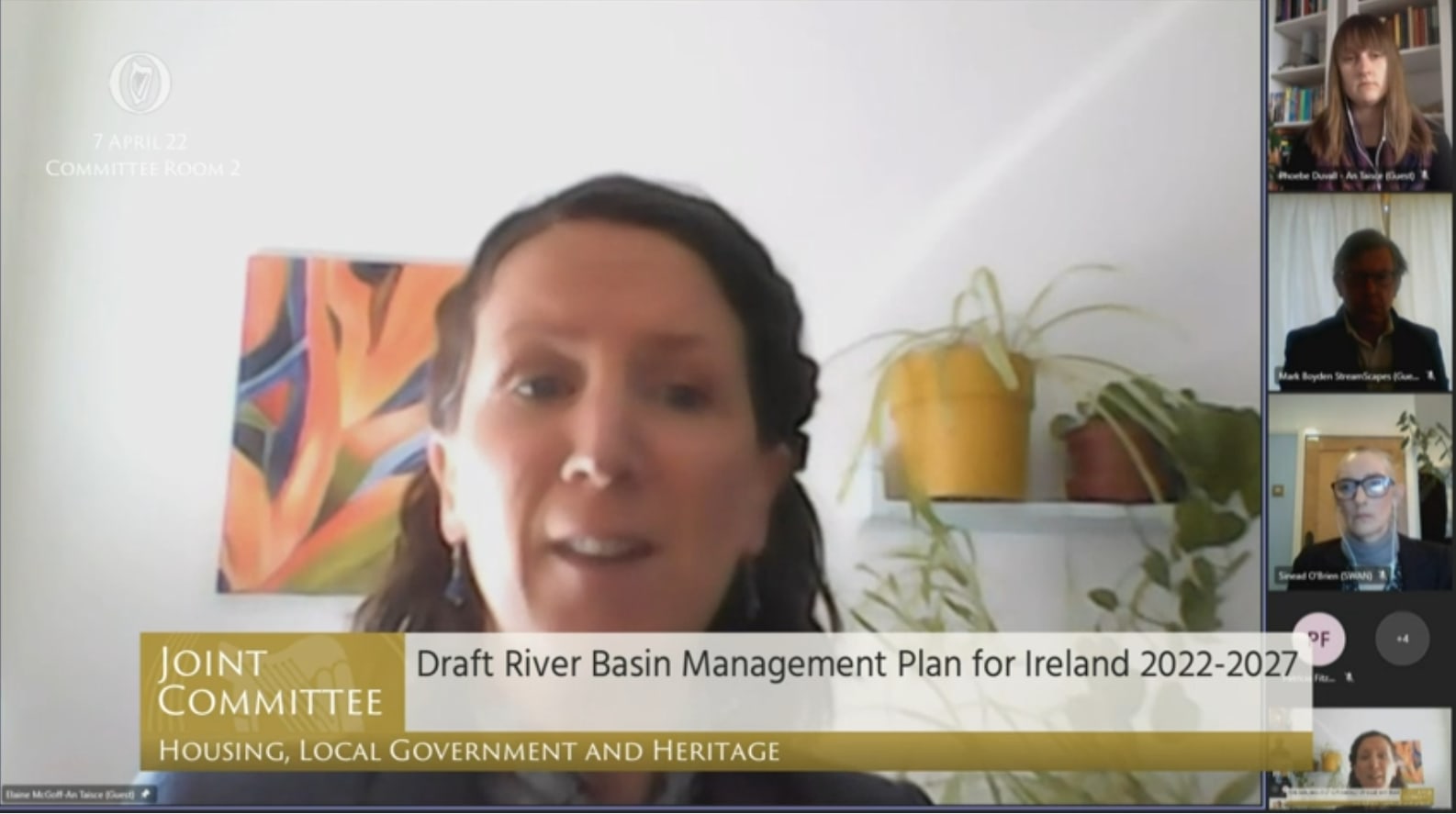
An Taisce presented to the Joint Oireachtas Committee on Housing, Local Government and Heritage on water quality and the Draft River Basin Management Plan, highlighting the particular impact of intensive agriculture on our waters. Colleagues from the The Water Forum and Sustainable Water Network also presented. Read the Opening Statement of An Taisce's Natural Environment Officer, Dr. Elaine McGoff and watch back below.
Read An Taisce's full submission on the draft River Basin Management Plan for Ireland 2022 - 2027 here.
Opening Statement
1. The Need for Change
This is the 3rd River Basin Management Plan (RBMP), and it comes in the midst of an everworsening water quality crisis- a crisis that is leading to loss of nature, swimming bans, drinking water contamination There are a number of catchments (13) in the South and South East such as the Barrow, the Slaney and the Lee which are of particular concern in regard to nitrate pollution from agriculture, and more than one third of all river sites (38%) have increasing levels of nitrate pollution. (1) Clearly radical changes are necessary in the management of nitrogen inputs to agricultural land to comply with EU Directives.
2. Agricultural Measures in the RBMP
The RBMP relies heavily on the measures proposed in the Nitrates Action Programme (NAP) and Good Agricultural Practice (GAP) regulations. Beyond that, the other measures proposed are voluntary, somewhat vague, not time-tabled or targeted.
This is why the reliance on the measures in the NAP is absolutely critical. If they fail, then the largest pressure on water quality will not be adequately addressed. In reality, if they fail, things will get significantly worse
2.1. Failures of the NAP
With that in mind, it should be of grave concern that the Department itself has acknowledged that the previous NAP failed because of agricultural industry expansion and poor compliance. To put numbers on that, the dairy herd has increased by approximately 50% since 2010, and artificial fertiliser import has increased by almost 40% in a similar timeframe. This pressure was clearly recognised in the documentation which accompanied the NAP, with environmental assessment (SEA) stating:
“… reduced stocking rates … offers greater levels of protection to the natural environment and is recommended … ”
and
“In a number of cases there is a clear driver from the natural environment for change … but this change has not been adopted within the draft NAP for economic reasons.”
It’s important to note that economics doesn’t come into the Nitrates Directive and can’t lawfully be used as an excuse to undermine environmental protection. We acknowledge that there have been some additional measures added to the NAP and GAP
regulations, which will partially address nitrate pollution, but they’re really inadequate to tackle it properly. I’ll just give you 3 examples.
a. Direct nitrate load onto grazing pasture
Teagasc were asked to do some modelling of various scenarios to inform policy decisions to
reduce nitrate runoff from agriculture (2). One of the main drivers identified was that cattle urine deposited directly onto fields leads to over 62% of nitrate loss. It is the main driver of nitrate loss, far above artificial fertiliser (29%) and slurry (8%), yet there is no mitigation for this provided in the NAP or GAP regulations. Why is this?
b. Fertiliser reductions
The NAP proposes reducing artificial fertiliser loads by up to 15%. EPA data (3)indicates that in some catchments in the south and southeast a 50% plus reduction in nitrogen load will be necessary to meet water quality standards. This begs the question, what percentage reduction in fertiliser is required to protect water quality in these catchments? Why did Teagasc not model this, they clearly have the capacity?
c. Compliance
Compliance with the Good Agricultural Practice (GAP) regulations is recognised by all parties as being low, and that fixing it is a key part of addressing water quality declines. However, the NAP doesn’t provide any new enforcement measures for the relevant authorities, and proposes open-ended measures such as reviews of local authority capacity, and ‘potentially’ targeting high risk areas. How can compliance be adequately addressed without tangible, time-tabled measures?
3. Recommendations
Having laid out the problems, I want to propose some recommendations for how agricultural water pollution could be addressed via the RBMP.
a. We need a catchment/waterbody based approach. Each waterbody will only have a certain carrying capacity for nutrients, and it’s time we took that kind of an approach and figured out what those thresholds are.
b. Introduce environmental risk assessments for all intensive farms, including derogation farms, through a permitting/licensing system similar to pigs and poultry. Intensification should only be permitted if it can be demonstrated that it won’t impact on water quality
c. For existing farms deemed to be a risk, regulatory, voluntary and combined measures should be implemented, including through herd reductions, with compensatory measures put in place to support this, where necessary. Most importantly, we need a solid evidence base that the measures farmers are putting in place are going to work. We know from the EPA what reductions need to happen and where,
Teagasc can model how we achieve those reductions, why hasn’t that link been made? Why aren’t we joining the dots?
It’s worth noting that a CSO study from last year found that 79% of people surveyed put water pollution as their top environmental concern above all else. (4) The reason that the public aren’t being louder about this is that water pollution is often invisible. But it’s only a matter of time before the public become aware of the scale of the problem we’re facing with our water quality and then they’ll be looking for answers as to why this was allowed to happen. The science couldn't be clearer, we need an ambitious and far reaching RBMP to address this, and as I have demonstrated, it is not enough to rely on the inadequate nitrates action programme.
(1) EPA (2021) Assessment of the catchments that need reductions in nitrogen concentrations to achieve water quality objectives
(2) Teagasc (2021) The Impact of Nitrogen Management Strategies within Grass Based Dairy Systems
(3) EPA (2021) Assessment of the catchments that need reductions in nitrogen concentrations to achieve water quality objectives
(4) https://www.cso.ie/en/releasesandpublications/ep/p-hebec/householdenvironmentalbehavioursenvironmentalconcernsquarter32021/