Banner image: Speaking at the event were An Taisce's Board and Committee members. Seen pictured in the central image in the banner above from left to right on the steps of An Taisce's traditional HQ Tailors' Hall Dublin — Dr Tony Holohan, One Health Committee Chair, Professor John Sweeney, Climate Committee, Terri Morrissey, Chair of An Taisce, Dr Aideen Ó Dochartaigh, Climate Committee member, Helen Shaw, Climate Committee Chair, and the President of An Taisce, Phil Kearney.
The EU Presidency's themes are Competitiveness, Security and Values but how does this translate to our climate priorities? An Taisce's expert briefing dismantled the data for a selection of media providing important insights and where Government spin starts to take over.
In recent weeks, a large amount of data and strategy documents have been released from the Government of Ireland but sometimes the numbers presented don't give a full picture of how we are doing as a country.
Facilitated by An Taisce's Climate Committee Chair, Helen Shaw and addressed by An Taisce Chair, Terri Morrissey, presenters were Professor John Sweeney, Dr Aideen Ó Dochartaigh and Dr Tony Holohan. Each honed in on different facets of climate from their expert standpoints. Also at the briefing were Dr Elaine McGoff, An Taisce's Head of Advocacy and Phoebe Duvall, Senior Planning and Environment Officer.
You can check out some of the media coverage around the briefing through these links: RTÉ 'Government urged to lead by example on climate during EU Presidency', Irish Independent 'Climate change expert accuses the Governement of 'spin' as Ireland lags far behind EU emissions cuts', ‘We are supercharging the extremes’: expert warns climate change is ‘topping up’ Ireland’s heatwave temperatures', and Virgin Media The Tonight Show 'Where's the plan for climate' panel discussion.
Professor John Sweeney, Climate Committee member and Professor Emeritus of Geography and Climatologist Maynooth:
- Download Professor Sweeney's full presentation slides — click here.
- Download 'Key Takeaway' notes — click here
Ireland is keen to present itself as a climate champion at international gatherings and to make commitments as part of what it identifies as part of a progressive group of nations. But when it comes to the implementation of commitments either at domestic or international level, short-term political considerations dominate. Meaningful mitigation of greenhouse gas emissions are avoided and tiny reductions 'spun' as major achievements.
Baseline figures for our Carbon Budgets were reduced as 16 million tonnes of emissions were essentially written off. Currently, we are storing up problems for further down the road with this methodology.
The agricultural lobby is very influential both inside and outside Ireland through sister organisations in Brussels having exceptional influence on domestic and EU-level policy through lobbying. The agri-food industry effectively disenfranchises smaller farmers and organic farmers.
Emissions are a big concern from Irish agriculture, 94 per cent of our methane and 92 per cent of nitrous oxide come from this sector. On a per capita basis, these are the highest in Europe. Methane emissions per dairy cow are increasing steadily as intensification proceeds. Claims by Teagasc that EBI (Economic Breeding Index) improvements are reducing methane emissions per cow are not substantiated.
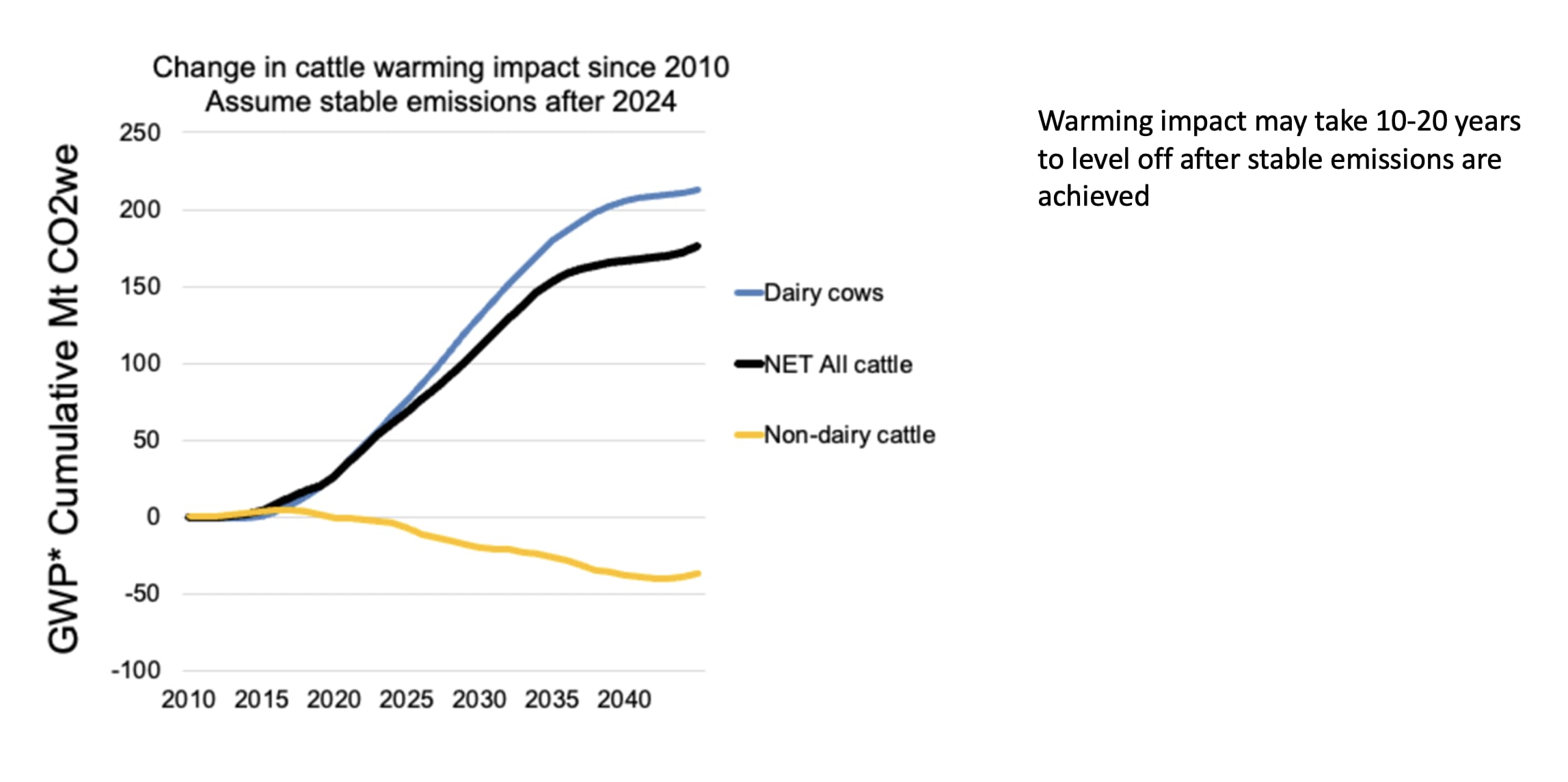
While the methodology for aggregating greenhouse gas emissions, Global Warming Potential (GWP???) is unlikely to change before 2030, supplementary methods such as 'GWP*' provide a better measure of additional warming relative to a base year for short-lived pollutants such as methane. Using GWP*, Ireland's agricultural sector is found to be the joint largest contributor to total additional warming of any EU Member State since 1990.
"The Government of Ireland portrays one message at an international level and another at the local level. We need to see through the spin of Ireland being a Climate Champion as the broad sweeping statements at international level aren't matched by actions at home.
"They are, for example, ignoring the Climate Change Act on three bills that are currently going through the Dáil, I think the downplaying of the Climate Act is something that will come back to rebound on the Government later on."
Dr Aideen Ó Dochartaigh, Climate Committee member and Associate Professor in Accounting DCU
- To download Dr Ó Dochartaigh's slides from the briefing, please click here.
Investment needs for climate and biodiversity are enormous at €700bn per year. Funding from the EU and how that is managed in Ireland through effective policy is critical.
There is an €865bn national and regional partnership fund, in which 35 per cent must be tagged as climate and biodiversity funding. The allocation method is an incredibly blunt instrument. For the EU's Multi-annual Financial Framework (MFF) 2028-2034 – NGOs are calling for 50 per cent but the EU has the allocation at 35 per cent (see above pie chart showing EU Budget breakdown.
Member state policy will define governance of the funds, ‘mainstreaming’ climate and biodiversity funding rather than 'ring fencing'. Using this blunt allocation method, airport terminals or new roads can theoretically be tagged as ‘environmental’ spending by individual member states. The categories and criteria of how this money can be allocated really do matter.
The European Court of Auditors, the EU’s independent external audit institution responsible for checking how the EU budget is collected and spent, and for ensuring accountability and transparency in EU finances have highlighted concerns that the budget is not meeting climate goals. Another note is that the overall 35 per cent is over the whole EU but member states can compensate between each other how this done and horse trading can happen between them to get to a collective total amount.
Useful resources
- Devitt et al (2026) EJNI: ejni.net/wp-content/uploads/2026/07/The-Irish-Presidency-and-the-MFF-01.07.26.pdf
- Guénard (2026) Germanwatch: www.germanwatch.org/sites/default/files/2026-03/Germanwatch_NRPP_Report_2026.pdf
- Williams et al (2026) EPRS: europarl.europa.eu/RegData/etudes/STUD/2026/780419/ECTI_STU(2026)780419_EN.pdf
Dr Tony Holohan, Chair of the An Taisce One Health Committee, member of the An Taisce Board and Director of the UCD One Health Centre
Climate change is no longer simply an environmental issue. It is already affecting human health across Europe and here in Ireland. The evidence is clear. Rising temperatures, more frequent and prolonged heatwaves, worsening air quality, extreme weather events, changing patterns of infectious disease and growing impacts on mental health are already affecting the health and wellbeing of populations.
The recent heatwaves across Europe, which resulted in thousands of excess deaths, are a stark reminder that these are not distant or future risks. They are today's reality. Ireland has so far experienced fewer direct health impacts than many other European countries, but we should not assume we are immune. As our climate changes, we need to become much better at understanding, measuring and responding to its effects on health.
At the same time, climate change is only one part of a much wider challenge. Too often we continue to organise ourselves in sectors while the challenges themselves ignore those boundaries. Climate, biodiversity, food systems, water, energy, housing, health and economic resilience are increasingly interconnected. Decisions taken in one area inevitably affect outcomes in another.
This is where One Health provides an important framework. It is not another policy agenda. It is a practical way of making better decisions by recognising the connections between human, animal, plant and environmental health. It encourages us to understand systems rather than individual problems and to develop solutions that deliver benefits across multiple sectors rather than solving one problem while creating another.
We already know many of the actions that will improve both population health and environmental sustainability. The challenge today is less one of evidence than of implementation. It is about bringing together government, academia, business, civil society and communities to work differently, informed by a shared understanding of these connections.
We also need to broaden how we think about resilience. Preparedness is not simply about emergency plans, hospitals, surveillance systems or scientific capability. It also depends on populations that understand the challenges they face and are equipped to participate in addressing them. Building public literacy, understanding and agency is not simply a communications exercise. It is a strategic investment in resilience. Better informed societies are better able to prepare for, respond to and recover from complex challenges while also being more resilient to misinformation and disinformation.
Equity must remain central to this discussion. The impacts of climate change are not experienced equally. Those who are already disadvantaged are often the most exposed to environmental risks and have the fewest resources to adapt. A fair transition requires us to recognise these inequalities and ensure that climate action improves health and wellbeing for everyone.
Ireland's Presidency of the Council of the European Union comes at an important moment. Its focus on competitiveness, shared values and security reflects the challenges Europe now faces. These should not be seen as separate priorities. Long-term competitiveness depends on healthy people, healthy ecosystems and sustainable food, water and energy systems. Security depends not only on defence and emergency response but also on preparedness, resilience and public trust. Our shared values are reflected in how we protect the health of people, communities and the natural environment on which future generations depend.
This creates an important opportunity for Ireland. We can help demonstrate that integrated thinking leads to better decisions and better outcomes. We can show that investing in healthier environments also delivers healthier people, stronger communities and more resilient economies. We can strengthen public understanding of these connections and support people to become active participants in shaping the future rather than passive recipients of policy.
Organisations such as An Taisce have an important contribution to make. By bringing together environmental stewardship, public health, education and civic participation, we can help connect these conversations and demonstrate that the solutions to many of Europe's greatest challenges are not found within individual sectors but in the spaces between them. If Ireland can use its Presidency to advance that understanding, it will leave a legacy that extends well beyond the six months of its term.
Speaker bios
- Professor John Sweeney is a prominent Emeritus Professor of Geography at Maynooth University, renowned for his climate change research and public outreach in Ireland. A former contributing author to the Intergovernmental Panel on Climate Change (IPCC) reports, he focuses extensively on climatology and bridging the gap between scientific communities and the public. Long-serving voluntary relationship with An Taisce and a member of An Taisce Climate Committee.
- Dr Tony Holohan is a public health physician with decades of experience in leadership, governance, and strategic policy at the highest levels. As Ireland’s Chief Medical Officer from 2008 to 2022, he led the national response to COVID-19 and today directs the UCD One Health Centre which is the first WHO Collaborating Centre on One Health in Europe. He works to advance a whole-systems understanding of health- one that integrates the human, animal, plant and environmental dimensions. He serves on the An Taisce Board and chairs its One Health Committee.
- Dr Aideen Ó Dochartaigh is Associate Professor in Accounting at DCU School of Business. She is an expert in sustainability accounting and responsible business methodology. Aideen O Dochartaigh research is interdisciplinary in nature and incorporates environmental social and governance (ESG) reporting practice and regulation, carbon accounting and budgeting, the circular economy and the bioeconomy. Aideen previously qualified as a chartered accountant (FCA), training in practice with Deloitte Ireland, and completed her PhD on sustainability accounting at the University of St Andrews in Scotland. She serves on a pro bono basis on the An Taisce Climate Committee and works on a voluntary basis with several climate and social justice community groups and NGOs in Ireland.