The Programme for Government 2025-30 may be the last opportunity for civil society to influence dramatic policy shifts before catastrophic climate and nature breakdown occurs. The scientific consensus is clear - the window of opportunity to limit catastrophic global warming is rapidly closing. Time has run out on incrementalism; our actions and inactions during this decade (2020-30) will directly determine the future of all inhabitants of planet Earth.
This election offers a pivotal opportunity for the people of Ireland to call for courageous, urgent, and radical action commensurate with the threat we face, and in line with our responsibility to secure a liveable future for everyone.
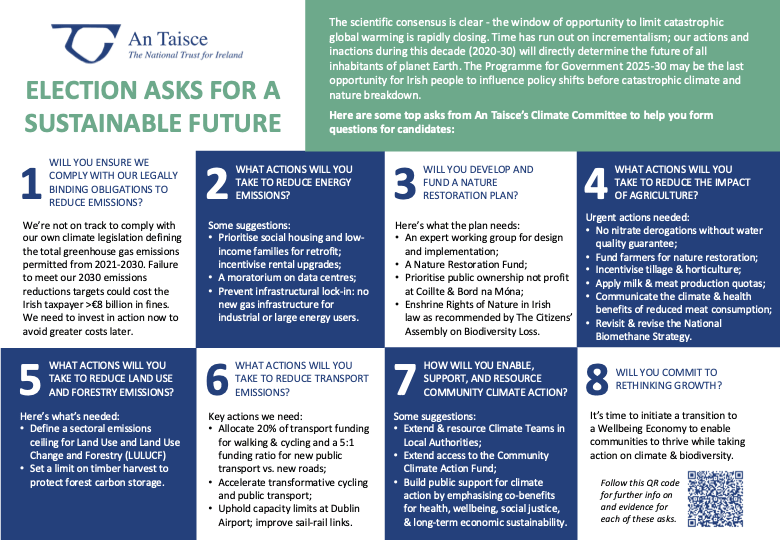
Here are some top election asks from An Taisce, to help you form questions for candidates:
-
Comply with our legally binding obligations. EPA analyses show we are not on track to comply with our Climate Action & Low Carbon Development (Amendment) Act 2021, which requires emissions reductions to adhere to 5-year carbon budgets (the total amount of emissions permitted under our legislation) of 295Mt (2021-25) and 200 Mt (2026-2030). Failure to meet the 2030 targets could cost the Irish taxpayer >€8 billion in fines.
-
Reduce energy emissions by:
-
accelerating retrofitting using low-carbon materials by prioritising social housing and low-income families and incentivising private landlords to upgrade rentals under The National Retrofit Plan.
-
placing a moratorium on data centre development until it is established that their emissions will not breach sectoral limits, leading to non-compliance with our legally binding carbon budgets.
-
preventing infrastructural lock-in: no new gas infrastructure for industrial or large energy users.
-
Develop and fund a National Nature Restoration Plan to ensure Ireland’s compliance with EU Nature Restoration Law and to enable a resilient natural world supporting people and planet, including:
-
an expert working group to design and monitor implementation;
-
a National Nature Restoration Fund (e.g., 0.5% of Corporation Tax revenue);
-
amending legal mandates of Coillte and Bord na Móna to prioritise public ownership and nature protection and restoration, not profit;
-
implementing the recommendations of The Citizens’ Assembly on Biodiversity Loss to enshrine Rights of Nature in Irish law.
-
Reduce the environmental impact of agriculture by:
-
granting nitrate derogations only where no impact on water quality is guaranteed;
-
funding farmers for nature restoration and rewilding;
-
supporting tillage and horticulture farmers and incentivising transition from dairy and beef;
-
publicly endorsing reduced meat consumption as essential to climate mitigation and health;
-
setting milk and meat production quota limits;
-
revising the National Biomethane Strategy to ensure that scientific evidence on serious negative impacts (methane leakage, excess fertiliser use, ammonia emissions) are addressed.
-
-
Reduce land use and forestry emissions by:
-
defining a sectoral emissions ceiling for Land Use and Land Use Change and Forestry (LULUCF). A missing ceiling for LULUCF means we cannot accurately assess compliance with carbon budgets;
-
setting a limit on timber harvest - excess harvesting relative to past planting is creating a significant rise in forest emissions due to the loss of carbon sink and forest carbon storage.
-
-
Reduce transport emissions by:
-
accelerating the delivery of transformative cycling and public transport projects;
-
addressing aviation emissions by upholding capacity limits at Dublin Airport and developing high-speed, low-carbon passenger ferry routes with seamless public transport connectivity.
-
Enable, support, and resource community climate action by:
-
extending, stabilising, and resourcing Climate Team contracts in Local Authorities, allowing them to lead transformative projects with continuity and strategic vision;
-
-
improving the accessibility and flexibility of the Community Climate Action Fund;
-
expanding evidence-based communication campaigns to build public support for climate action by emphasising co-benefits of climate action for health and wellbeing, social justice, and long-term economic sustainability in a shared vision for a sustainable and resilient future.
-
Address the underlying driver of emissions and ecological breakdown by rethinking growth and initiating a transition to a Wellbeing Economy, to enable communities to thrive while taking action to restore and protect our living planet, securing a liveable future for all.