Banner photo: ©UN Climate Change - Kiara Worth
As world leaders prepare to gather for the 31st UN Climate Change Conference, the stakes for climate justice have never been higher.
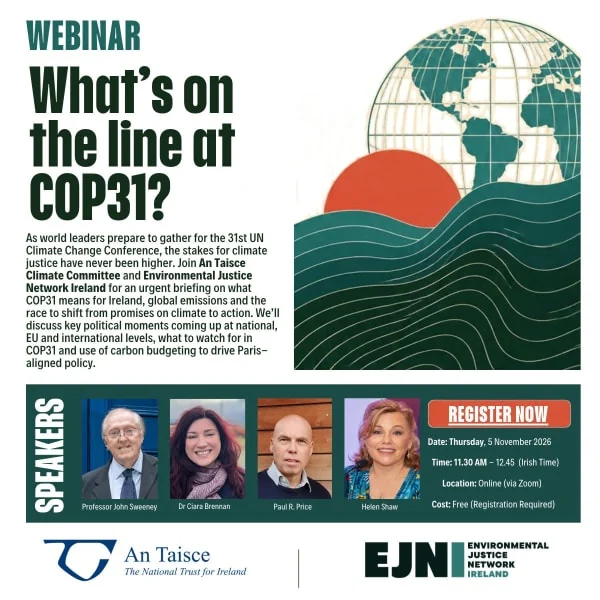
An Taisce Climate Committee and Environmental Justice Network Ireland's urgent briefing is available to watch back on what COP31 means for Ireland, global emissions and the race to shift from promises on climate to action. They discuss key political moments coming up at national, EU and international levels, what to watch for in COP31 and use of carbon budgeting to drive Paris-aligned policy.
Speakers: Professor John Sweeney, Dr Ciara Brennan, Paul R. Price and the panel discussion is moderated by Helen Shaw.
Watch back full webinar via Environmental Justice Network Ireland website.
At a joint expert briefing, Thursday Nov 5th, ‘What’s on the line in COP31?’ Environment Justice Network Ireland (EJNI) and An Taisce’s Climate Committee (ATCC) called for Ireland and the EU to accelerate action to phase out fossil fuels at COP31, the global UN climate conference that opens in Antalya, Turkiye next week. Ireland hold the EU Presidency and leads EU diplomacy at COP31 but according to Professor John Sweeney, the eminent climate scientist and a member of ATCC, Ireland’s international climate advocacy is being undermined by its failure to deliver climate action at home. Dr Ciara Brennan, Director, EJNI said: “Ireland and the EU must place justice, fairness and equity at the centre of the negotiations in Antalya and that means recognising and taking steps to address the gap between promises and meaningful action at home."
COP31 marks 31 years of annual conferences tracking implementation of the UN Framework Convention on Climate Change, signed by 198 countries in 1992. it is the framework agreement underscoring the Kyoto Protocol 1997 and the Paris Agreement, 2015. The Paris Agreement is a legally binding commitment, signed by 196 countries, to work to limit global temperature increase to 1.5 degrees Celsius above pre-industrial levels. COP31 marks 31 years of annual conferences tracking implementation of the UN Framework Convention on Climate Change, signed by 198 countries in 1992. it is the framework agreement underscoring the Kyoto Protocol 1997 and the Paris Agreement, 2015. The Paris Agreement is a legally binding commitment, signed by 196 countries, to work to limit global temperature increase to 1.5 degrees Celsius above pre-industrial levels.
Last month the UN Environment Programme (UNEP) reported in its Emissions Gap Report that limiting global warming to at or below 1.5 degrees Celsius was no longer achievable. Paul Price, a carbon budgets climate researcher and member of ATCC, said the UNEP report should motivated the COP31 negotiations to go further and faster on mitigation. “If we're going to overshoot 1.5, that doesn't mean we should go to 2.2.5 or 2.8. We should be going as hard as we can”.
John Sweeney, Emeritus Professor at Maynooth University, said “Ireland’s climate change performance will come under increased scrutiny at COP31”, He said numerous policy failures in emission mitigation placed Ireland near the bottom of the EU league table. He said that Ireland’s policy actions, including €6 billion in fossil fuel subsidies this year, were at odds with its previous COP commitments, including the Methane Pledge and the elimination of inefficient Fossil Fuel Subsidies.
COP31 is co-hosted by Australia and Turkiye with Australia holding the role of President of Negotiations and ensuring the existential position of Pacific Ocean islands like Tuvalu is on the agenda. Next year Ireland will co-host the Transitioning Away from Fossil Fuels (TAFF) conference with Tuvalu. Given the significance of Ireland’s global climate diplomacy in both COP31 and the 2027 TAFF conference Dr. Brennan said the credibility of Ireland’s vital diplomatic role “will be shaped by national progress towards meeting our climate commitments “. Professor Sweeney said without that Ireland’s diplomacy resembled “the Emperor’s no clothes”.
Paul Price accused the Government of evading accountability by accepting national climate targets will be missed and disapplying the 2021 Climate Act. He referenced the 2026 national Climate Action Plan update, which is expected to be published next week, and said “to reduce exposure to future cost shocks and climate impact risks, the long overdue Climate Action Plan update urgently needs to ensure that Ireland gets back on track, to give households, businesses and farmers a reality-based roadmap”.
To find out more about COP31 visit: https://cop31.tr
Further reading:
EJNI’s series of briefings on Ireland’s role as Presidency of the Council of the EU in steering the EU’s long term budget towards climate action and a just transition.