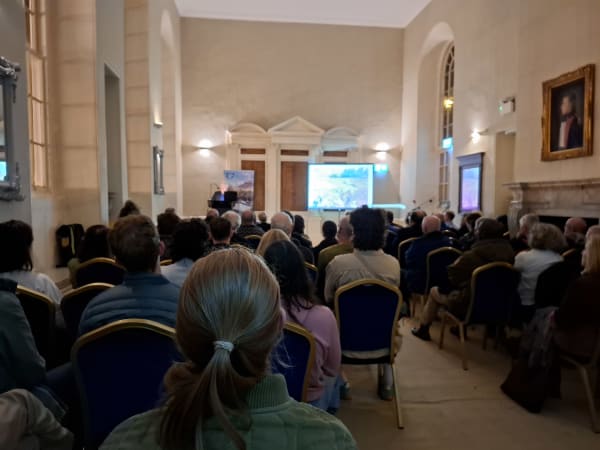
This text is taken from a sold-out lecture by Professor John Feehan — The Nature Restoration Regulation: last best hope for peatland rewilding?[1] that took place in Tailors' Hall on 13 October 2026. Professor John Feehan is well-known for his award-winning television work on the natural and cultural heritage of the Irish landscape. His many books include definitive textbooks, such as on Ireland's peatlands, Farming in Ireland: History, Heritage and Environment, and The Wildflowers of Offaly as well as books on the geology, environmental heritage and history of the Midlands.
I was born the same year as Bord na Móna; and our shared birthday gives me a span of years sufficient to appreciate the scale of change in the peatland landscape since the great industrial machines began to strip the bogs of their once-off harvest.
When I was young we cut our own turf in Clonoghil Bog outside Birr (the last intact raised bog to be taken into production by Bord na Móna). Back then it still had a lake at its heart, with a fringing forest of royal ferns taller than our young heads, and patrolled by the first dragonflies to fire my young imagination.
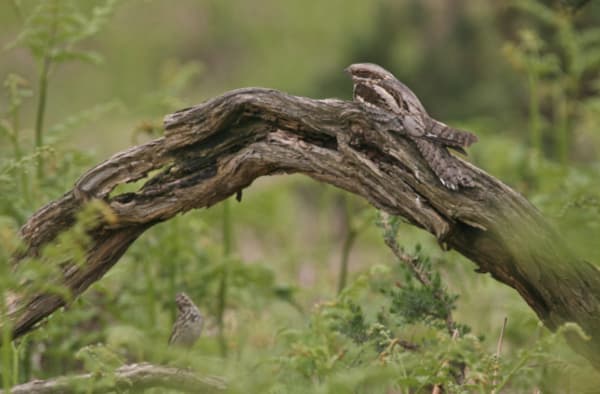
I remember, almost to the point of still hearing them now, the last nightjars flickering among the heather and between the pines at dusk, on turf-cutting early summer evenings. When I left Birr to make my way in the world it never crossed my mind that when I returned the nightjar would be gone: that I would never hear it again. I don’t think we ever really imagined that not only would the nightjar disappear, but that the bog itself would be gone in our lifetime. Image above: nightjar on bog wood.
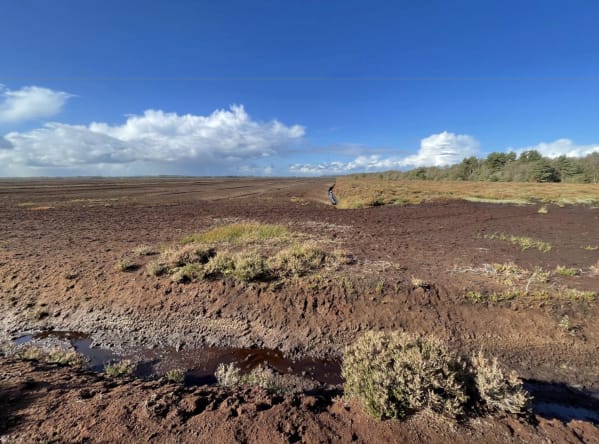
This is Clonoghil Bog today.
Because back then the bogs went on forever. I don’t have the words to give you any real sense of the extraordinary places these bogs were before we began to exploit them on an industrial scale: the immense silence and sense of solitude, the total absence of a human presence except along the fringes where turf was cut by hand; the sheer wonder of the lives of the plants and animals that made their homes here.
Looking back on that time in later years, Professor J.J. Moore, who spent a lot of time walking the bogs in the 1950s and 60s studying their flora, remembered what it was like before systematic mechanical cutting began (This is from a talk he gave in the 1980s): an experience which it is impossible to have anymore – the experience of being isolated in a vast brown ocean of bog, extending to the horizon on all sides, where the only landmarks were church steeples. One always needed to carry a compass in these vast areas. This experience can no longer be enjoyed since all these larger bogs of up to 10km diameter have now been cut. At present we have no undrained raised bog left which is more than 300 ha in extent.[2]
So much of the natural wonder of the bog was unseen, unheard by us then, preoccupied as we were with the exhausting exhilaration of harvesting the turf. It only began to come into focus on subsequent visits years later, when the spread-ground had taken on the abandoned feel of a school playground during the summer holidays – except that here there would never again be a return to life and laughter in September.
In the early days of Bord na Móna the end of industrial harvesting seemed so far into the future it was hardly considered. There was a fuzzy idea that we would have an area of extra productive land the size of a new county, but experimental work soon showed the productive limits of cutaway bog for farming or forestry. The ecological value of cutaway was scarcely at all appreciated in the beginning by plant or animal scientists. It was thought of as little more than a brown desert, of little value for plant and animal wildlife. When the Irish Peatland Conservation Council was set up in 1982, inspired by the surveys of Professor Moore and his students in the Department of Botany in UCD, its early focus was on the preservation of a representative sample of the few relatively intact bogs remaining.
At the time Bord na Móna began work in the late 1940s the value of bogs rested exclusively on its productive function. Global warming and the biodiversity crisis did not exist for us when Bord na Móna was established in 1946, nor was there any awareness of the population explosion and the challenge of feeding 10 billion in a water-challenged world. The word ‘biodiversity’, indeed, was only invented in the late 1980s. All of our attention was on the task of coaxing into flame the glowing embers of an economy that had very few natural resources at its disposal. The great hope was that the large-scale industrial strip mining of the raised bogs, the one resource that we had an abundance of – an unlimited abundance as it must have seemed in the beginning – might be the start of a more prosperous age. And indeed it did transform life in the Midlands by that significant increment through the late 1940s and 50s: to the threshold of, and on into, the new era of prosperity we now enjoy.
A growing awareness
It was really only with the wake-up call of the UN Environment and Development Conference in Rio de Janeiro in 1992 – the forerunner of the annual COP gatherings – that we heard the first whispers of looming environmental disaster, whispers that have now, 34 years on, become the loudest of shouts for urgent and immediate action. There is scarcely a day goes by without our being reminded that the world is burning, and what the consequences for our life on this planet will be a century from now, and still all the graphs that record progress to counter the effects of climate change, the unprecedented loss of biological diversity, and resource depletion: all the graphs continue to go in the wrong direction. But most of us are now aware, in a way we never really were before, that unless we grasp the nettle of climate change, we face disaster: not you and I personally perhaps, not our adult generation, but without a shadow of doubt our children and their children into an endless future.
Our children will be here in fifty years, when oil will be too precious to burn. In the warmer world of 2050, with a world population approaching 10 billion, with biodiversity reduced as never before, at a time we will have come to appreciate as never before the full spectrum of functions it serves in human life, cutaway bog will come to be treasured as the last place on our Midlands doorstep to which we can retreat from our frenetic world in order to experience contact with nature.
New eyes on cutaway bog
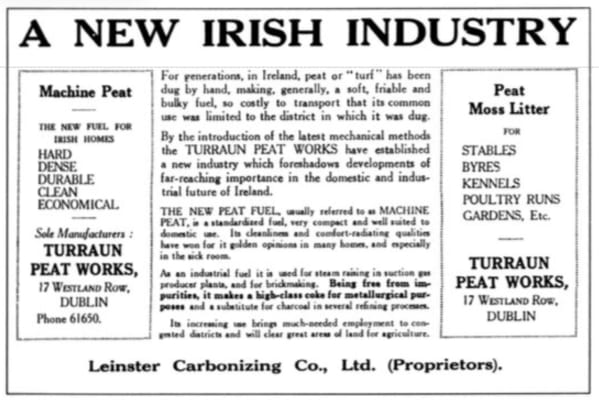
What opened our eyes regarding the biological diversity of cutaway bog was Turraun, a very deep and extensive bog in what is now the Lough Boora Parklands, situated right beside the Grand Canal, enabling fuel to be transported cheaply to Dublin. Here, in the early 1920s the visionary Sir John Purser-Griffith established one of the first machine turf operations, to show on a small scale what could be done on a much larger scale throughout the Midlands of Ireland. A few years later, in 1935, Turraun was bought by the Turf Development Board, the forerunner of Bord na Móna.[3]
Because of its early start, as the first bog to be mechanically developed in a systematic way, Purser-Griffith’s Turraun was the first bog to be ‘bottomed’ or finish extracted by Bord na Móna. The underlying marl was reached in the early 1970s, and production was gradually phased out from about 1973, and around 120 hectares of the 570 hectare bog complex were abandoned to nature. All that remained was a variable but generally thin layer of peat overlying deep marl. The old bog drains were still there, now cutting deep into the marl, and a few higher areas of glacial gravel rose above the general level of the cutaway bog here and there.
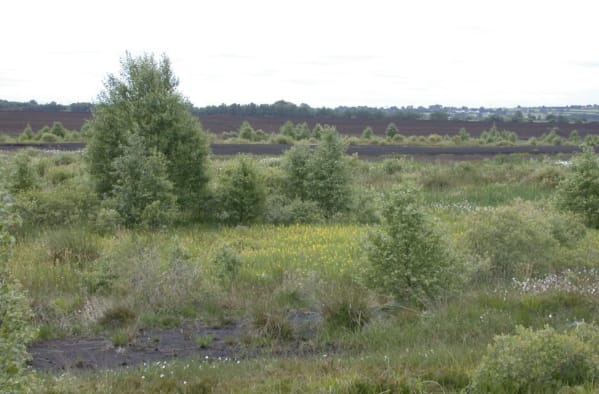
But what nobody at that time had any experience of, was the potential of disturbed peatlands to develop a very high level of biological diversity as a result of their inherent ecological vitality: albeit biodiversity that is different from that of the natural habitats they replace. Once harvesting activity comes to an end – indeed, before it in many cases – natural processes of recolonisation take over on the cutaway, and in time the bare surface is replaced by a mosaic of evolving ecosystems of great ecological interest that develop on the residual peat. There will be woodland and scrub, dominated by pine, birch and willow. There will be oases and fringes of natural acid grassland, fen, marsh and small areas of bog, with considerable areas of shallow open water and the marginal habitats associated with it. And, most importantly, these spontaneously established new ecosystems are in ecological equilibrium with the changed conditions which human exploitation of the original bog has brought about.[4] At Turraun itself, after less than 20 years, something like 160 species of flowering plants and ferns were recorded, and the number of bird species present was over 50, half of them breeding here, including the rare grey partridge.
Cutaway and cutover bog have the potential to become a new wild place big enough for a great diversity of flowers and shrubs and trees, ferns, mosses and liverworts, birds and mammals and countless smaller animals, many of whom lived in the raised bog and its associated habitats: along with many others that would have been rare or altogether absent before the new ecosystems provided a place for them. We can now envisage a wildland mosaic reserve of National Park extent and commensurate importance and potential, as close to wilderness as anything can be.
This is a classic example of a phenomenon eloquently elucidated back in 1980 by the Nobel nominee René Dubos:
Ecosystems … undergo adaptive changes of a creative nature that transcend the mere correction of damage; the ultimate result is then the activation of certain potentialities of the ecosystem that had not been expressed before the disturbance … We can improve on nature to the extent that we can identify these unexpressed potentialities and can make them come to life by modifying environments, thus increasing the diversity of the earth and making it a more desirable place for human life.[5]
Restoration
When we talk about peatland restoration, what we mean is the restoration of biodiversity and of the lost function of carbon sequestration. We do not, except in exceptionally favourable hydrological and ecological situations, mean the restoration of raised bog. ‘Rewetting’ is not restoration. Getting a bog back to a pristine state by blocking drains and rewetting the surface is only possible in exceptionally favourable hydrological and ecological situations.
In a raised bog, the living zone of active peat formation – what hydrologists call the acrotelm – disappears very early on, and conditions are rarely adequate to its subsequent re-establishment. If peat removal ceases at some intermediate stage, the result is usually the development of a type of dry heath of limited ecological value and with limited biodiversity. The general public is often misled into thinking all that is needed to get the bog back to a pristine state is to block drains. This may be possible at an early stage in development, but once the water table has been lowered and the acrotelm – the living zone of active peat formation – removed, it becomes impossible to restore to active raised bog, or at least prohibitively and unrealistically expensive. It’s not like a forest that you can re-plant and it will grow back if you wait long enough. The late-glacial topographic and drainage regime that provided the templates for the formation of raised bog are gone and – especially critically – climate change is taking us in precisely the wrong direction. It will require direct intervention in the decades and centuries ahead to prevent the small area of relatively intact raised bog we still have from being colonized by pine and becoming something else. It’s not like 100 years ago when you might come across what they used to call ‘Sassenach’s Cuts’ deep in a bog that had simply gone back to being a bog once the attempt to drain it had been abandoned: or it had been stripped of its sphagnum moss to make wound dressings, as happened during World War 1.
The most significant long-term ecological opportunities for cutaway bog do not relate to raised bog restoration, but to the development of a carbon sequestering wild-land of enormous biological diversity: not that of the vanished bog, but of comparable ecological value: and this applies not just to protected sites, but to industrial cutaway bog as a whole.
A moderate level of engineering intervention (e.g. to block outflow) will often facilitate development of the diverse mosaic of habitats that will naturally develop over time. A case-by-case approach is important. There are scores of degraded bogs, of all shapes and sizes, in the midlands. Most are circled with birchwood on the old turf-ground, all with much in common, but each with its distinctive features also, and all of them calling for community care and management. Together they can constitute a network of biodiversity reserves – large and small – many of them linked through ribbons of less intensively-managed farmland, and potentially enhanced through this connection.
Succession
From the earliest days in the development of the modern discipline of ecology little more than a century ago there was great emphasis on the key concept of ecological succession: that the ecosystem evolves through a series of balanced transitional communities known as seres towards a natural climax community.
But the pace of this change is not chronicled in the years our impatient mayfly eyes are able to see. The climax community towards which ecologically degraded peatlands are naturally evolving is not reached in ten or twenty years, but over centuries: and when attained it will endure for centuries beyond, without our help: in a world where these restored areas of natural habitat will be the great surviving reservoirs of natural diversity in this part of Ireland. But that recovery is not easily hurried, and our understanding of the ecological processes that underpin it is very limited. It is tempting to intervene in a way that shows we are doing something – and gives results that can be seen and applauded in a few years, but in many cases that is more likely than not to delay – or derail – the natural progression towards the optimal outcome of a stable climax vegetation, and optimal biodiversity.
A phrase attributed to Gregory Bateson springs to mind: ‘The major problems of the world are the result of the difference between the way nature works and the way man thinks.’
The transitional communities through which the habitat evolves are shaped by the nature of the soil and allied factors: and the ecology of this soil is as complex as anything we see above ground, but poorly understood by comparison – in part simply because it is out of sight and so, as so often happens, out of mind. This is why the nature and extent of our intervention needs to be so carefully considered in advance.
Keeping all this in mind then, it is deeply instructive to look at what has happened along the temporal trajectory of degraded bog restoration in the areas where natural ecological succession is more advanced – although still less than a century old: in the peripheral aureole of old turbary that encircles all raised bogs, where turf was harvested for generations by hand. These areas have a critical and under-appreciated role to play in the future evolution of the bogs. Here we get to see something of that fourth ecological dimension of time, and catch a glimpse of how limited our ability to predict the course of ecological succession is: we simply don’t know a fraction of enough about what is going on in the web of ecological transactions below ground.
Our Once and Future Forest
In no more than a few decades, an initial grassland seral stage is replaced by woodland, in which a preliminary ecological survey will report a modest level of plant and animal diversity. Birch is the primary coloniser in most of these areas, but birch is old at 100, and is now approaching old age in many areas. But over the century of its presence the soil has been transformed in a way most immediately (albeit superficially) evident to our usually less than observant eyes in the diversity and profusion of the mycorrhizal fungi that peep briefly above ground in the autumn.
This transformed soil provides an ideal seed bed for longer-lived forest trees. Already pine, oak and yew are beginning to establish an early foothold: an astonishing glimpse of the future these woods are moving towards, all the more so when you consider how restricted local seed sources for oak and yew are at present. And their longevity is the time frame against which we need to envision and work towards that Once and Future Forest of a century, three centuries, five centuries, hence: when our children will still be here, looking back with incredulous eyes that we should have been so blind: when these will be the only places where the true wilderness remains.
The first of these longer-lived woodland trees to appear is the native European pine that has been living quietly at the edge of the bog down all the centuries, descendants of the great trees whose stumps were so regularly encountered by the great machines of Bord na Móna as they reached ever further back into the buried past centuries of the raised bog’s growth.
Many of these are magnificent trees of immense beauty and presence, completely different from the stands of Scots pine cultivars sometimes planted on cutaway or cutover bog. And we have the assurance from recent research on European pine genetics (from our own Colin Kelleher and his colleagues across Europe) that these are to be regarded as native trees. One intervention therefore that should be more carefully evaluated is the possibility of collecting the seeds and transplanting the seedlings of these trees, especially in suitable areas of industrial cutaway.
This successional trajectory is something no ecologist would have expected or predicted back in the 1970s, and it underlines the importance of always being conscious of the informal Third Law of Ecology elucidated by Barry Commoner back in 1971: ‘Nature knows best. Any major man-made change in a natural system is likely to be detrimental to that system. And when we do intervene, we need to know not only what the effects of our intervention are going to be, but what the effects of the effects will be.’[6]
The future is in our hands
The cutaway bogs present us, as a community, all together, with a unique and once-off opportunity at this most appropriate of timings to act ourselves to bring about a truly significant act of ecological restoration. This is – or has the potential to become (in terms of biodiversity and carbon capture) – our rain forest. This is the one corner of the world’s biodiversity we can save with our own hands and hearts, and in doing so preserve the values and functions it represents in our lives: putting into practice our determination that there should be biodiverse wild places for future generations not just in theory from a concerned global perspective, but that there will be THIS wild place forever on our community doorstep, for which we are directly responsible. This is the only corner of the world in which we can do this through direct, personal action: in the process raising our own awareness of the issues involved, and kindling opportunities for further engagement as well as school curricular development.
Often, as we reflect on the enormous challenges we face in our time, it is easy to feel helpless: to feel that there is little we can do apart from using the influence of our voice and vote to get those who represent us politically to echo all our voices on the national and international stage. But we are often reminded of the importance of connecting what is a global challenge back down to our local environment.
The first step is to bring these areas within the embrace of the community living around the bog, whatever the measures we take to facilitate their progress towards the future of optimal biodiversity to which their ecological succession is taking them. In many cases little or nothing needs to be done in the short term, and in all cases never without careful study of that fourth dimension in ecology, deeply conscious of the time-frame across which the natural succession to that optimum is achieved.
And we should be clear in our minds at the outset that the over-arching aims are the restoration and enhancement of optimal biodiversity and carbon sequestration function, other aims being important but secondary: giving very careful thought at the start as to how these aims can best be achieved and balanced.
The significance of the Nature Restoration Regulation
It is against this background that we need to appreciate the critical significance of the Nature Restoration Regulation, our Irish draft of which, as most of you will know, went to Brussels on September 1st. …
The Nature Restoration Regulation is Europe’s implementation of the Global Biodiversity Agreement, which came out of COP15 in Montreal in 2022: requiring governments to put in place measures to restore to good condition habitats that are currently not in good condition, by 2030 on at least 30% of its territory, giving priority to areas within the Natura 2000 network, on 60% by 2040, and 90% by 2050.
As things stand, here in Ireland we spend the lowest amount among EU member states on nature, at only 0.9% of GDP compared with the European average of 2.2% a year;[7] 90% of protected habitats here are in ‘unfavourable’ conservation status, placing us in the bottom 10% globally for biodiversity intactness. In the bottom 10%.[8]
The success or failure of the new Regulation will colour the horizon or background of natural heritage in all of its facets in different ways in the decades and centuries ahead, in the Midlands in particular through the role of peatlands in the recovery of nature: and in particular with regard to the future of the great industrial cutaway bogs that are such a defining feature of the landscape of the Midlands.
It may be thought that the future of these bogs had all been decided by now; Bord na Móna has decided that the best after-use for most of the large industrial cutaways is to turn them into wind or solar farms, and the best use for those that are not suitable, is to regenerate them by rewetting, which is understood by the general public to be more or less synonymous with ‘restoration,’ giving the impression that you are restoring the conditions that allows them to regenerate as bogs. But as we saw earlier, ‘rewetting’ is not restoration.
Natural habitats are not dependent on us to restore biodiversity. It is built into them by processes it took tens – indeed, hundreds – of millions of years to develop: processes that evolve through a series of balanced transitional communities (the seres we met earlier) towards a natural climax community. During each of these stages a habitat is colonized by a complex of flora and fauna that makes optimal use of the resources available during that particular stage; and that complex changes with the passage of time, as the resources available change and as environmental circumstances – such as climate – change.
Explicitly addressing Bord na Móna, the Independent Advisory Committee on Nature Restoration, ‘recognising the commercial mandate of Bord na Móna … its shareholders should require the objectives of the company to explicitly include the protection, promotion and enhancement of biodiversity and ecosystem services, and the restoration of relevant habitats specified in the EU Nature Restoration Regulation.’ Notice: ‘explicitly include: not as a subsidiary tag, but, as the report states further on, recognizing that ‘nature and biodiversity require a focus on par with climate’: in other words, equal value.[9]
Just as truly as the poet Thomas Hood, in one of his sonnets, could find true silence not ‘where hath been no sound, or where no sound may be’, but in those places where people once lived and worked, but later abandoned:
where Man hath been,
Though the dun fox, or wild hyaena, calls
And owls, that flit continually between,
Shriek to the echo, and the low winds moan, –
there the true Silence is, self-conscious and alone.
Just as truly can biodiversity be as alive, as vibrant in parts of the world to which we have put our exploitative hand, as it can be alive in the very fewest of places in which nature has been left alone.
Allowing nature to follow this optimal course is ‘rewilding’ in its deepest and most meaningful sense: As defined in a recent key paper by 33 leading academics in the area of restoration science, ‘it’s giving nature the space and time to dictate its own ecological trajectory. It’s not based on some predetermined outcome, on what we want things to look like. There’s a distinction there to be made between rewilding and ecological restoration, where you could say that all rewilding is restoration, but that not all restoration is rewilding.’[10] And recent studies are showing that rewilding in this sense stores carbon at rates higher than tree planting.[11]
You might think it is too late to alter course in our priorities for cutaway bog as a whole, but this is where the Nature Restoration Regulation comes in. Because a decision has been taken to locate wind farms on so many of them does not have to mean we have missed this one final opportunity to restore wild nature to them. If you will allow me to reinterpret a line in one of Gerard Manley Hopkins’ poems,
And for all this, nature is never spent;
There lives the dearest freshness deep down things.[12]
A wind farm is not forever. Thirty years – a single human generation – is as long as it lasts. The ever-turning circle of ecological succession continues while the blades of the turbines revolve over those 30 years. If our eyes are clearly focused on the horizon of an ecological climax where biodiversity is optimized, reached not in decades but in centuries, they can be dismantled if necessary: or they can stay where they are while nature continues towards that horizon. There are temples and palaces in centuries-old climax rain forest in other parts of the world. The most important thing the new Regulation requires of us is to go back to the drawing board to look again at each bog on a case-by-case basis, giving climate and nature equal value in our reassessment. And, lest we forget, the ace in the political hand when it comes to telling Bord na Móna what to do, is that Irish Government holds 95% of the shares in Bord na Móna.
We hear calls for priority to be given to the restoration of habitats on public lands, especially since actions to achieve the aims of the Nature Restoration Regulation are voluntary for private landowners and will have to be incentivized accordingly. The Independent Advisory Committee on Nature Restoration bluntly states that ‘the measure of our ambition for nature on public lands will determine the success of meeting the obligations outlined by the EU Nature Restoration Regulation and reversing nature decline in Ireland.’
Another key recommendation of the Advisory Committee is that when it comes to restoration at a landscape scale, cutaway bog is the only habitat of sufficient extent where the nature restoration and re-establishment called for can come about in any meaningful way. Cutaway bog, and the all-important turbary fringes enclosing them, where communities harvested their household fuel for centuries before mechanical peat-winning arrived on the scene.
But it will take political will, and the vision to really understand that nature restoration is equal to climate action in importance. There is little sign of political will if last week’s budget is anything to go by. It will require a political change of heart – something in the nature of the ‘conversion’ Pope Francis called for in his great encyclical Laudato si’ – because here is the problem: we just don’t get this. We just don’t get this. Nature restoration is not, as we used to think in resigned times before the golden penny slipped from our hand: not the best we can do in the sense that there is nothing better in money-making terms we can manage: but in the sense that this is the best we can do. This is the best thing for us to do.
The Advisory Committee describes the Nature Restoration Regulation as ‘a generational opportunity’. But this vision of the rewilded bogs is not a project for a year or for fifty years, but for centuries, becoming ever richer as time goes by and nature re-establishes its green hold across the bog. This is how we can best contribute, at individual and community level, to the healing of the natural world in the Midlands, responding to the challenges set out in our National and Local Biodiversity Action Plans, and now in the Nature Restoration Regulation.
This is what Aldo Leopold’s famous ‘Thinking like a mountain’ means in the Irish Midlands context. ‘Thinking like a Mountain’ means adopting a holistic view: having a complete appreciation of how each of the elements within an ecosystem is connected to, and affects, everything else: and considering the long-term consequences of our actions on nature, and not only their immediate effects.[13]
In the warmer world of 2050, with a world population somewhere around 10 billion, with biodiversity reduced and confined as never before at a time we will have come to appreciate as never before the full spectrum of functions it serves in human life, the harvested bogs will have come to be treasured as the last place on our Midlandsdoorstep to which we can retreat from our frenetic world in order to experience contact with nature. John Muir knew what he was talking about when the wrote that ‘the clearest way into the universe is through a forest wilderness.’
So may I conclude with another quotation from René Dubos:
Human beings need primeval nature to re-establish contact now and then with their biological origins; a sense of continuity with the past and with the rest of creation is probably essential to the long-range sanity of the human species.[14]
[1] Images are all courtesy of Professor Feehan from his original presentation of the same name.
[2] Quoted in John Feehan et al., The Bogs of Ireland, page 479.
[3] All of this is discussed in detail in the early chapters of The Bogs of Ireland.
[4] John Feehan (2004). A Long-lived Wilderness. The Future of the North Midlands Peatland Network.
[5] René Dubos (1980), The Wooing of Earth.
[6] Barry Commoner (1971). The Closing Circle. Nature, Man and Technology.
[7] European Environment Agency (2025).
[8] National Parks and Wildlife Service (2025); Cathal and Fitzgerald (2023).
[9] Independent Advisory Committee on Nature Restoration Recommendations (2026), page 14.
[10] Carver, S. et al. (2021) in Conservation Biology.
[11] Quoted in Isabella Tree (2026), Future Rural: Imagining Tomorrow’s Countryside. Little Toller.
[12] Gerard Manley Hopkins (1877, ‘God’s Grandeur.’
[13] ‘Thinking like a Mountain’ is a very short – but profoundly influential – essay in Aldo Leopold’s A Sand County Almanac and Sketches Here and There (OUP, 1949, 129-133). The essay can easily be downloaded from the Internet.
[14] René Dubos (1976), Science Volume 193.