Banner image: The UNFCCC family bids farewell to UN Secretary-General António Guterres and thanks him for his steadfast commitment to climate action Photo: © UN Climate Change - Kiara Worth
COP31 — The First Week
By Professor John Sweeney
The annual Conference of the Parties to the United Nations Framework Convention on Climate Change (COP) rotates between continents to minimise travel for the near 200 participating states. COP31 is being held in the southern Turkish town of Antalya, a city which has become the capital of Mediterranean tourism in Turkey. The historic old town with its layers of Hellenistic, Roman, Byzantine and Ottoman remains is now ringed by several kilometres of 6-12 storey apartment blocks and beyond these a further few kilometres of ‘Las Vegas-style’ hotel resorts which make for a sprawling city of 1.5 million people. A bus journey of up to 1.5 hours is required to reach the COP venue located on a wetland 20kms east of the Old Town.
Progress at COPs has been underwhelming for almost all of the past 31 years. Only two occasions stand out (Kyoto and Paris) where all countries came determined to make progress. The main reason for failure is the requirement for unanimity in all decisions. This gives a veto to any country to scupper the overwhelming wishes of the global community, most recently seen in the veto exerted by the oil producing states on any mention of fossil fuels in the final communique. Each year, the participants meet to formally ratify that such a voting requirement will continue and this year was no exception. Having attended this meeting, it was striking that it was only two small nations that convincingly raised the issue: Monaco and Tuvalu. Perhaps it is something that also suits some of the bigger states to thwart proposals they don’t like in other areas.
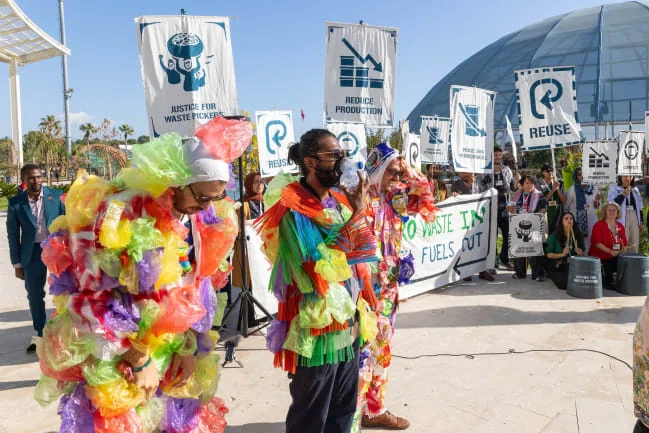
Pictured — members of civil society demonstrate at COP31 (Photo: © UN Climate Change – Kubilay Ciftci)
The scale of the COP is hard to visualise. Over 97,000 people are registered to attend. The diversity of languages, dress and the activities of the various national pavilions makes for interesting days of listening, learning and a lot of foot slogging trying to find particular places and times. For the first time, as befitting its EU Presidency role, Ireland has its own pavilion, mainly sponsored by Irish financial organisations. Irish officials sit side-by-side with their EU counterparts at the various negotiating tables. Given how many simultaneous themes are involved this must stretch personnel resources a lot, and to be fair, the performances this observer has witnessed thus far indicates that Irish officials have a good grasp of their brief.
The conference is unique in another way this year in that it has two co-chairs: Turkey and Australia, a compromised reached because both wanted COP31. Neither country has a distinguished climate record. Turkey’s National Determined Contribution envisages an increase in its emissions from 2018 by around 40% by 2035. As the second largest coal exporter in the world, emissions from Australian coal and gas exports have almost doubled since 2005. Both countries have agreed to propose a rather modest target for a COP outcome of committing nations to increase the share of electricity in final energy demand to 35% by 2035. Ireland is currently around 24%. Of course such a target would reduce emissions from fossil fuels, but the benefit would occur especially if fossil fuels are not used to drive the electricity consumption. This is the area of debate at present and the EU in particular want this proviso. Watch this space.
UN Secretary-General Antonio Guterres is on his final visit to COP before his term ends. As always, he pulled no punches pointing out that in the last quarter of the year alone, the nine largest fossil fuel corporations made $95billion in profits. Meanwhile the UN’s Loss and Damage fund amounted to a total of $600 million i.e. what these companies made in 14 hours. One wonders if the several hundred fossil fuel lobbyists at COP were listening to his call for governments to tax these windfall profits. One might have. Reports indicated the CEO of EXXON was due to speak in Antalya, registered as part of a US Chamber of Commerce party! But this appearance was cancelled.
Participants are curious about Ireland’s record in tackling climate change and often seek an alternative view from Irish civil society as opposed to the filtered version from official sources. The facts provide a very different picture. While the EU has reduced its emissions by 40% since 1990, Ireland has managed 5% and is on target to fail both its 5-year carbon budgets as well as its EU obligations. Its performance in reducing methane emissions and phasing out fossil fuel subsidies also is very different from the COP obligations it signed up to over the years. The reality is reflected in a slide down the Climate Change Performance Index league table to 37th position. This is largely due to policy failures, something perhaps for the Minister to reflect on.
At the end of week one the officials have done their work and need political choices to be made. This where the late nights and compromises kick in. The next few days will be crucial in determining whether action matches ambition. The slogan of COP31 is: “Dialogue, Consensus, Action”. Are we to see a score of 3-0, 1-2 or as many COPs have ended – a no scoring draw?