Terri Morrissey, Chair An Taisce — the National Trust of Ireland
Belle Tout Lighthouse: A beacon of conservation architecture in Beachy Head
I was invited to the Belle Tout lighthouse on Beachy Head, Sussex South Downs, England, on October 20, to launch the next phase in its the evolution by a colleague of mine, Rob Reaks, who is the marketing manager for the lighthouse. The event was organised to showcase the lighthouse as a unique venue for Bed & Breakfast and to demonstrate how a unique landmark could be sympathetically renovated and put to use as a special venue for visitors to enjoy. The event was attended by over 50 people who had a connection in someway to the landmark.
Members of the various families who had restored the lighthouse at their own expense; a number of local dignitaries, including the Lady Mayor of Eastbourne; the CEO of the Sussex Downs National Park, in which the lighthouse is situated; and members of the local council, all spoke enthusiastically about the preservation work.
Photo: Terri Morrissey with Rob Reaks, Belle Tout marketing manager
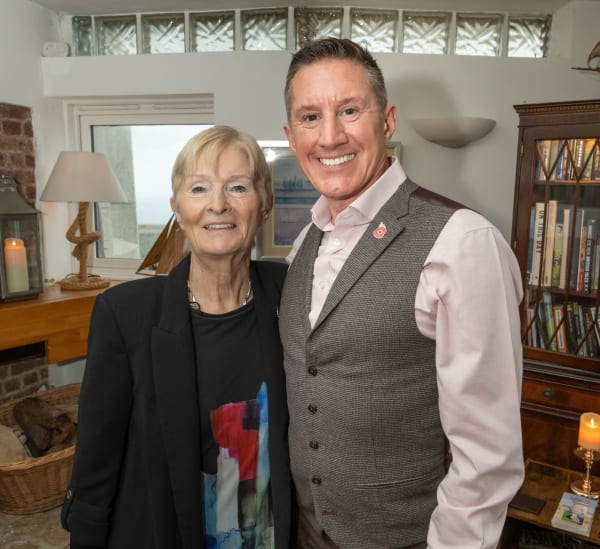
It is a wonderful example of the care taken to preserve the uniquely situated lighthouse.
It had to be physically moved away from the crumbling chalk cliffs (see image below), which were being battered by the sea, and which would have claimed the building except for the care and dedication of a number of families. (See brief history below)
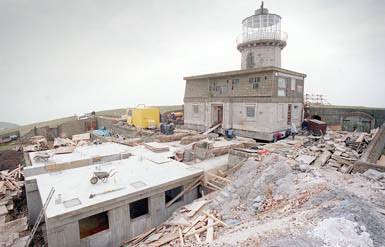
History of Belle Tout
The building of Belle Tout, started in 1829 to the design of W. Hallett and J. Walker, using huge blocks of Aberdeen granite. Its lamps were first lit on October 11th 1834. Sea mists often hugged the cliff tops, obscuring the light and causing many ships to perish. As the shipwrecks continued, in July 1899, work began on the erection of the present Beachy Head lighthouse at the foot of the cliffs and on October 2nd 1902, Belle Tout was decommissioned and sold.
During the Second World War Belle Tout was left empty, see image below, its owners having been evacuated from this vulnerable part of the English coast.
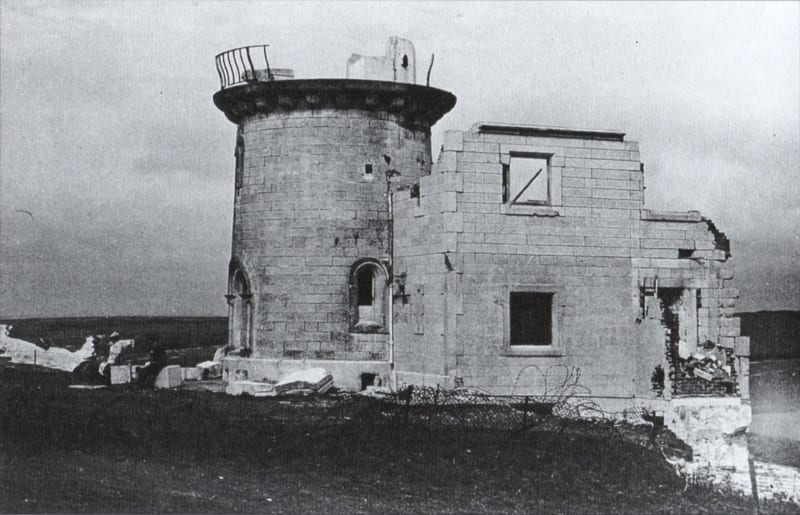
By 1942 a firing range had been constructed some 200 yards east of the lighthouse. The Canadian troops, blasting away with everything from light howitzers to cannons, used old cars as targets, but managed to hit Belle Tout several times.
Privately restored in 1956 (by the Cullinan family), the lighthouse was moved back from the cliff edge in 1999 (by the Roberts family) and further restored in 2008 to the Bed and Breakfast it remains today by the Shaw family.
Today, the lighthouse sits away from the cliff edge, but according to local conservationists it may have to be moved again in order to avoid falling into the sea.
The CEO of the National Park, Sion McGeever, reckons that in order to manage in a changing environment you need to adopt a RAD approach. RAD is a framework for deciding how to respond to environmental change, including climate change and coastal erosion. It was developed for managing changing ecosystems and is also useful as a way of thinking about adaptation more broadly.
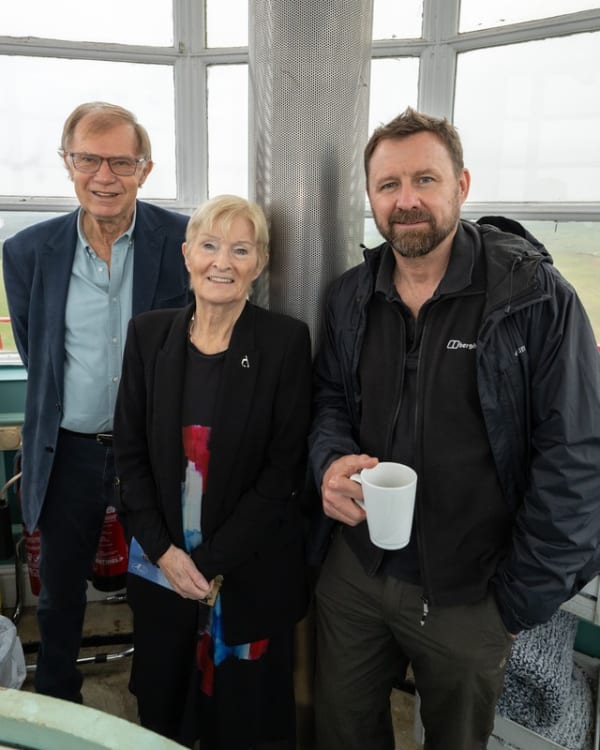
Photo: Terri Morrissey is with Sion McGeever, CEO, Sussex Downs National Park & Dr Richard Plenty in Belle Tout Lighthouse.
Which approach is adopted depends on the nature and severity of the challenge and the feasibility of the success of the approach :
- R stands for Resist: Take action to prevent or slow the change, preserving existing conditions. For cliff erosion, this might mean building sea defences or using rock armour to protect the coastline.
- A stands for Accept: Allow the change to happen, recognising that intervention may be too costly, impractical or undesirable. For example, allowing a cliff to erode naturally and relocating buildings or infrastructure away from the coast, as with Belle Tout.
- D stands for Direct: Actively shape the change towards a preferred future. This might involve redesigning coastal areas, restoring habitats or managing land use so that the coastline can evolve in a way that benefits both people and nature.
The key insight is that resisting change is not always the best response. Sometimes accepting change or deliberately guiding it towards a different future is more sustainable.
The RAD framework encourages decision-makers to consider what they want to achieve, what is feasible, and how their strategy might need to change over time. Different approaches can be appropriate in different places, or at different stages of environmental change.
Final Note: Belle Tout located in The Sussex South Downs National Park
In 1926, the Crowlink Estate, which comprised 480 acres of land along the top of the Seven Sisters cliffs between Seaford and Eastbourne in Sussex, was bought by a building syndicate for £9,750. In an effort to prevent development taking place, the Society approached the syndicate to buy the land to protect it.
See the link to an article about this and the role Rudyard Kipling played:
https://friendsofthesouthdowns.org.uk/kipling-and-the-seven-sisters/