Carbury Castle is a multi-period structure featuring –
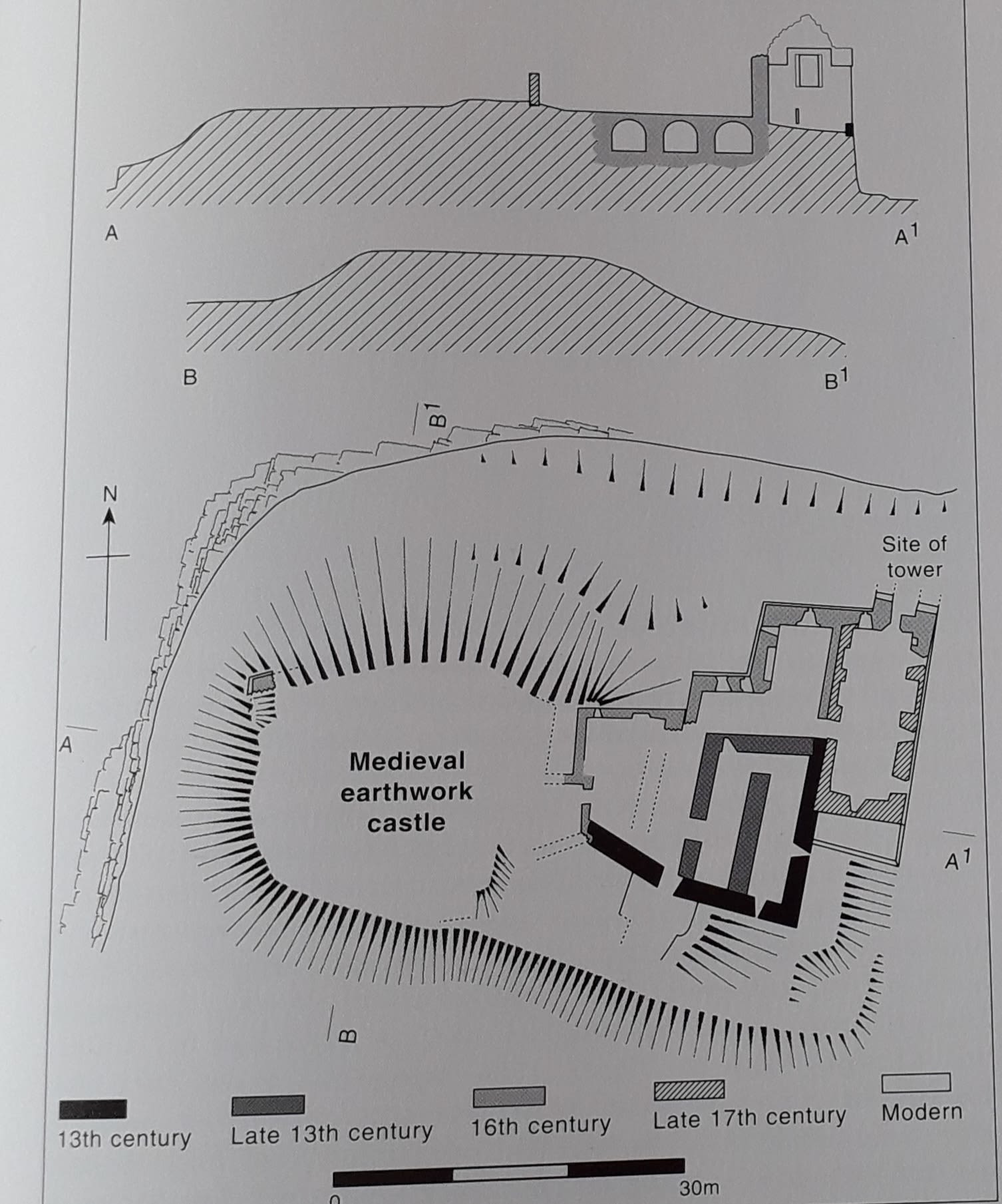
- A probable 12th century earthwork castle/motte [KD008-001001].
- Abutting the earthwork on its eastern flank, a 13th century masonry castle [KD008-001002].
- The castle was enlarged to the north and east in the late 16th/early 17th century [KD008-001003].
- 18th/19th century alterations with landscaped gardens [KD008-001004].
There is also the possibility that the church remains [KD008-001005], lying 80m downslope, had a Medieval origin and thus an association with the castle complex.
‘Carbury Castle is a multi-period fortress sited on high ground in a very isolated area with no obvious easy access to it. It is, however, close to a graveyard and church which could originally have been contemporary with the building of the earthwork castle which is sited immediately to the west of the stone fortress. Also, like Loughcrew and Knowth, there are prehistoric burial mounds which are located on higher ground to the south of the castle’ (Sweetman 1999, 38).
The lands of Carbury were granted in the late 12th century to Meiler FitzHenry by Strongbow (Devitt 1899, 92). He was probably responsible for the construction of the original earthwork castle. Upon his death the holdings would have reverted to Strongbow’s heirs. Thus in 1189, Carbury came into the possession of William, Earl Marshall, the husband of Strongbow’s daughter Isabel (ibid., 93).
The first specific mention of the castle was in 1234. In that year a ‘mandate (was given) to Hugh de Lascy, Earl of Ulster, to give seisin to the messenger of Gilbert, Earl of Pembroke, of the castle of Cabry in his custody owing to the war between the King and Richard Earl of Pembroke’ (CDI 1875, i, 323). In 1249 the Justiciary was instructed by the King to grant Margaret, Countess of Lincoln, wife of Walter, late Earl Marshall, seisin of the castles of Kildare and Carbury (ibid., 446).
By the 14th century the castle was in the hands of the de Bermingham family. The family remained prominent throughout the following centuries. In 1319 John de Bermingham was created Earl of Louth. In 1329 he was slain during a siege of his castle at Braganstown by the gentry of that county. In 1368 a parley was held between the Irish and the English in Carbury. The Berminghams exploited the situation and seized Thomas Burley, Prior of Kilmainham and Chancellor of Ireland, John FitzRichard, Sheriff of Meath, and several others. The Chancellor was subsequently handed over in exchange for James Bermingham, who had been held, ‘in handcuffs and fetters’, in Trim Castle (Butler 1842, 154-5).
On the 23rd of October 1554 ‘Henry Cowly’ was granted a lease of ‘Castlecarbre’ – the castle, its demesne lands, along with other lands, for example Kylemore and Derrygarte (DKR 9 1877, 63). The Cowly/Colley family were ancestors of the Duke of Wellington (Mac Lysaght 1982, 209).
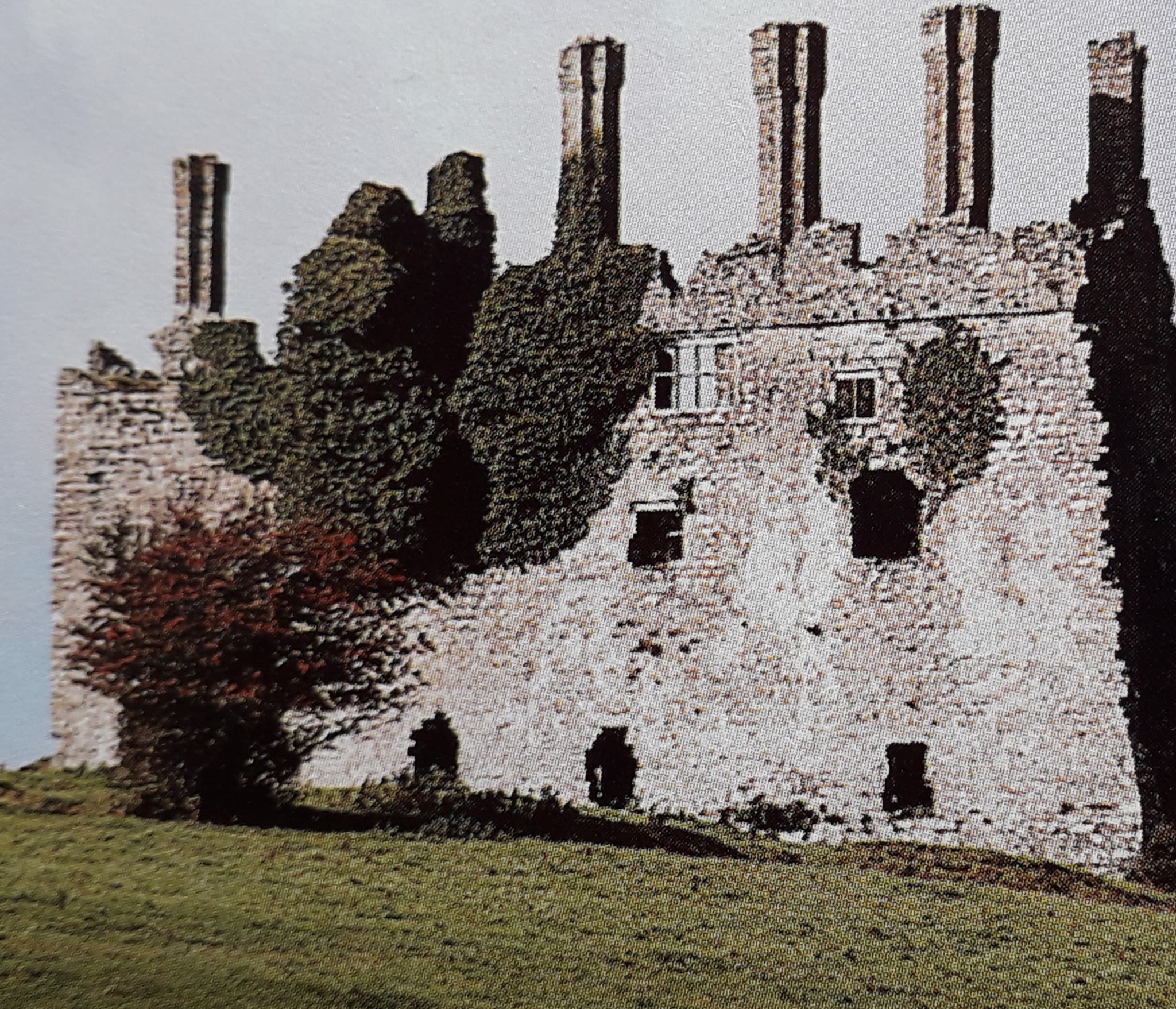
The crowning glory of Carbury Castle are the unrivalled examples of Elizabethan/Jacobean-style chimneys (see attached photograph). Whilst castles at Enniscorthy in County Wexford and Newtownstewart in County Fermanagh have similar examples, none are as perfectly realised as those at Carbury. It is these chimneys that are, by their very nature, currently under the greatest threat unless stabilisation work is urgently undertaken. Their avoidable loss would simply be unforgivable. Destruction by neglect.
Sir William Wilde wrote – ‘…with its chimneys, narrow pointed gables, and large stone-sashed windows… (it’s) one of the best specimens of the castellated mansions of about the time of James the 1st’ … ‘Four of the chimneys, three of which are in the eastern front, have sixteen sides, … being beautifully wrought and moulded at the top’ (Wilde 1849, 28).
David Sweetman, former Chief Archaeologist of the National Monuments Service, has stated – ‘Carbury Castle was surveyed because I thought it was an extremely important site (see attached plan). Few sites have such a continuous occupation with obvious periods of building from the Anglo-Norman fortification to the Elizabethan period. The site is obviously a dangerous structure and because of its uniqueness it would be great if stabilisation works could be undertaken’ (Pers. comm., PDS).
To achieve proper stabilisation, and to maintain ongoing maintenance, it is imperative to take this valuable monument-rich complex into the care of the State.
References:
Butler, R. (ed. & Trans.) 1842 Jacobi Grace, Kilkenniensis, Annales Hiberniae. Dublin. Calendar of Documents relating to Ireland, 1171-1307, Vol.1. 1875, London.
Devitt, M. 1896-99 ‘Carbury and the Birmingham’s country’, JKAS 2, 85-110.
Mac Lysaght, E. 1982 More Irish Families. Dublin.
Report of the Deputy Keeper of the Public Records and Keeper of the State Papers in Ireland: Ninth report. 1877, Dublin and London.
Sweetman, P.D. 1999 The Medieval Castles of Ireland. Cork & Woodbridge.
Wilde, W.R. 1849 The Beauties of the Boyne, and its tributary, the Blackwater. Dublin.